James Calvin Casherego

Zachariah Thatch and James Casherego (alias George W. Wilson) were traveling together through the Creek Nation. They had left Springdale, Arkansas, on April 12, 1895, in Thatch’s full wagon drawn by Thatch’s horses, looking for property for Thatch to purchase.

Seeing a rich target, Casherego robbed and killed Thatch the next day. When Thatch’s body was discovered on May 26, suspicion immediately went to Casherego, who was promptly arrested. Thatch’s property was still in his possession.

At trial in Fort Smith in December 1895, Casherego’s defense that Thatch had sold the goods to Casherego and gone of to purchase land on his own was rejected. He was found guilty on December 19 and sentenced to death.

After his conviction was affirmed on appeal, on July 30, 1896, James Casherego became the last man to be hanged at Fort Smith. In May, 1896, Congress ended the authority of the U.S. District Court for the Western District of Arkansas over the Indian Territories. Judge Isaac P. Parker, who had presided over that court since 1875, died on November 17, 1896, after 160 death sentences and 79 executions.

Eduardo Ray Gonzales

Born in Mexico in 1867, Eduardo Gonzales was living near Caddo, Indian Territory.

On May 10, 1893, John Daniels was teaching singing at church when Gonzales, who knew Daniels from church, shot and killed him. Gonzales was arrested a few hours later.

Investigation revealed that Gonzales, whose face had been disfigured, resented Daniels for having barred him from singing because his appearance offended the women in the class.

Gonzales was convicted in U.S. District Court for the Eastern District of Texas in Paris, Texas, on November 28, 1893, and sentenced to death.

With James Upkins and Mannon Davis, Eduardo Gonzales was publicly hanged in Paris, Texas, on March 30, 1894.

Mannon Davis

Mannon Davis was born in Tennessee in 1863 and spent his early adulthood in Texas, before moving into the Choctaw Nation in 1890.

While living in Eagleton (in present-day southeast Oklahoma) with John Roden and Roden’s wife, Davis came to believe that Roden intended to kill him. Confronted by Davis on December 26, 1891, Roden denied any such intentions. Davis persisted in his accusation before stabbing and killing Roden.

Davis fled. He was tracked down and arrested the next day in Arkansas by Deputy Sheriff Dollarhide on a federal warrant. Davis was returned to Paris, Texas.

Tried in the U.S. District Court for the Eastern District of Texas in Paris, Mannon Davis was convicted and sentenced to death.

With Eduardo Gonzales and James Upkins, Mannon David was publicly hanged in Paris, Texas, on March 30, 1894.

In an unusual turn of events, Davis’s brother, Miller, was so upset at the treatment of his brother that he drugged, stabbed, and killed the officer who had arrested him. For that killing, Miller Davis was convicted in Arkansas state court and hanged in November 1893.

James Upkins

On September 6, 1893, James Upkins was arrested for raping his six-year old daughter in Ardmore, Indian Territory (present day south central Oklahoma).

Tried in the newly established U.S. District Court for the Eastern District of Texas in Paris, Texas, Upkins, who was Black, was found guilty on December 12, 1893, and sentenced to death.

Austin American-Statesman, December 13, 1893

Along with Mannon Davis and Eduardo Gonzales, who had also been convicted of capital crimes committed in Indian Territory, James Upkins was publicly hanged in Paris, Texas, on March 30, 1894. A large crowd had gathered to witness the event.

Upkins’ case is one of only a handful of federal executions that did not involve a murder.

Jake Tobler and Joe Tobler

Fran Cass and A.P. Goodykountz were prominent cattle merchants from Vinita, Cherokee Nation, traveling west on business. En route, they stopped in the Sac & Fox Agency in the Indian Territory.

Brothers Jake and Joe Tobler were staying in the same area. Recognizing Cass and Goodykountz as affluent, the Tobler brothers, who were Black, shot and killed the two men on August 16, 1885. They then stole their horses, wagons, and possessions.

Three days later, a posse captured and arrested the Toblers, who promptly confessed. The men were jailed at Fort Smith, Arkansas.

Chetopa (Kansas) Advance, September 10, 1885

After being transferred to Wichita, Kansas for trial, they were tried separately in federal court in September 1888. The reason for the lengthy delay is not clear.

After being found guilty and sentenced to death, Jake and Joe Tobler were hanged in Wichita on November 21, 1888.

Charles Julius Guiteau

Charles J. Guiteau was an unstable, ambitious, and probably delusional young man. His efforts to make a career in law, theology, and writing had come to naught. His efforts on behalf of various politicians, though of little consequence, led him to believe that he would be rewarded with a prominent patronage position. Over the course of the 1870s, his estrangement from his family increased as his mental health worsened.

Believing that his newly elected President James A. Garfield, whom he supported and believed he had played an important role in electing, was intent on abolishing the patronage system he sought the favor of, Guiteau developed a plan to kill Garfield. Vice President Chester A. Arthur, Guiteau believed, would look more favorably at his record.

Guiteau purchased a pistol, trained in using it, and began following Garfield, looking for an opportunity to shoot him. On July 2, 1881, he shot Garfield at the Baltimore and Potomac Railroad Station in Washington, D.C. Garfield died on September 19, 1881, due to infections related to his wounds.

Guiteau, who was arrested immediately after the shooting, was indicted on murder charges on October 14, 1881. His trial in the Supreme Court of the District of Columbia began on November 14.

Despite his insanity defense and his increasingly bizarre behavior, Guiteau was found guilty on January 25, 1882, and sentenced to death. After his appeal to the US Supreme Court and his clemency request to President Arthur were rejected, he was hanged on June 30, 1882, in Washington, D.C.

James Leighton Gilmore

Bicente Ortez, James Gilmore, and a crew of others worked driving cattle from Pierre to Deadwood, in the Dakota Territory, in June 1879. When Gilmore became upset with Ortez, he shot and killed him. The murder occurred on the Sioux Reservation.

Though the crew allowed Gilmore to escape, he was arrested two years later, in August 1881. At trial in the US District Court for the District of Dakota Territory in November 1881, he was convicted and sentenced to death.

Subsequent investigation indicated that Gilmore may have been involved in a number of other killings since arriving in the Territory from Ohio.

On appeal, Gilmore, the son of a prominent Ohio family, argued that he was of unsound mind. That appeal was rejected, as was his father’s plea to President Arthur for clemency.

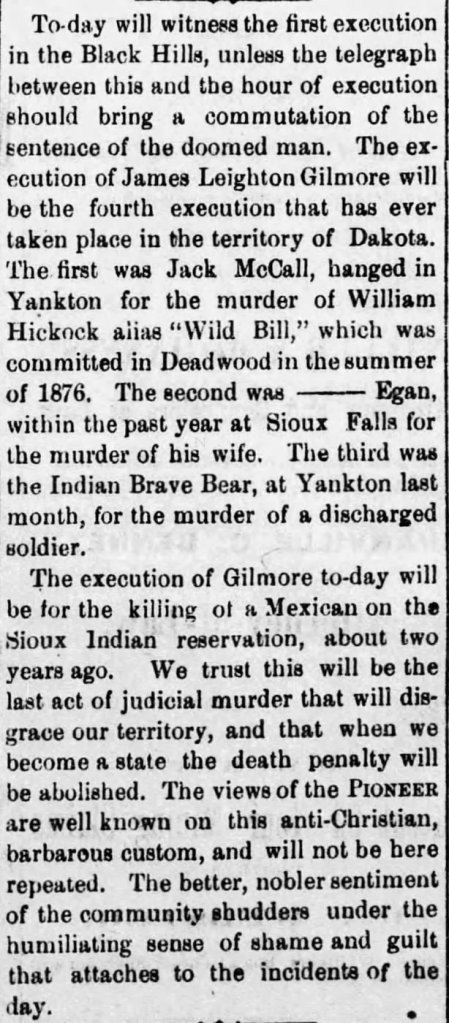
Though it was widely expected that his connections would ultimately spare him, James Gilmore was hanged in Deadwood on December 15, 1882. The Daily Deadwood Pioneer Times of that date described it as “the first judicial murder in the Black Hills.”

James Lamb and Albert O’Dell

Edward Pollard and George Brassfield worked as tenant farmers growing cotton near Lebanon, Chickasaw Nation. James Lamb and Albert O’Dell worked for them. Over the course of their tenure, Lamb became involved with Pollard’s wife and O’Dell became involved with Brassfield’s wife.

As O’Dell and Lamb became more bold in pursuing these relationships, Brassfield reportedly felt threatened and left. That freed O’Dell to make plans to marry Mrs. Brassfield. Those plans were made for December 27, 1885.

On December 26, Mrs. Pollard induced her husband to go to town to shop. He never returned.

The next day, Brassfield and O’Dell were married. The minister refused Lamb’s request to marry him and Pollard. The two couples then left the area.

Two months later, Pollard’s body was found. O’Dell and Lamb were immediately suspected and soon arrested. O’Dell confessed.

At trial in the US District Court for the Western District of Arkansas, the men offered testimony implicating each other. They were convicted on September 18, 1886, and sentenced to death.

James Lamb and Albert O’Dell were hanged at Fort Smith, Arkansas, on January 14, 1887.

John Stephens

On May 28, 1886, John Stephens borrowed a horse from his former employer, Charlie Whitefeather, and rode to the home of Anna Kerr, where he killed her and her son, Louis Winter. He then rode to the home of Dr. James T. Pyle, attacking and killing him and seriously wounding his wife. The incidents occurred near Bartlesville, Cherokee Nation.

Evidence at the scene pointed toward Stephens. When he was arrested, Stephens, who was Black, had Whitefeather’s horse.

Though no motive for the killings was established, speculation centered on the possibility that Kerr’s husband, from whom she was separated and on bad terms, had hired Stephens. Mr. Kerr was arrested but never charged. There was also evidence that Stephens had been involved in a previous dispute with Pyles.

John Stephens was convicted in U.S. District Court for the Western District of Arkansas, and sentenced to death on October 30, 1886. He was hanged on January 14, 1887.

John T. Echols

On February 16, 1886, John Echols shot and killed John Pettenridge in the Chickasaw Nation. The murder followed a dispute over the sale of some horses. Echols believed that Pettenridge had failed to deliver his end of the bargain.

When Pettenridge said that he was too busy to meet Echols demand to be made whole, Echols found him and killed him.

Echols, a white man born in Fulton County, Georgia, was convicted of first-degree murder on August 20, 1886, and sentenced to death.

John T. Echols was hanged at Fort Smith, Arkansas, on January 14, 1887.