Documenting and Analyzing the History of Federal Executions
Author: Bill Lofquist
I am a sociologist and death penalty scholar at the State University of New York at Geneseo. I am also a Pittsburgh native. My present research focuses on the history of the death penalty in Allegheny County (Pittsburgh), Pa.
Alfred Bourgeois was a LaPlace, Louisiana-based truck driver. His two-year daughter, Jakaren Harrison, sometimes traveled with him. While making a delivery to the U.S. Naval Air Station in Corpus Christi, Texas, on July 27, 2002, Bourgeois viciously beat and killed his daughter.
Bourgeois told police and emergency personnel that his daughter had fallen out of his truck. However, post-mortem examination revealed a long history of horrific abuse. That evidence was subsequently corroborated by family members.
Because the murder occurred on a military base, federal charges were filed.
At trial in the U.S. District Court for the Southern District of Texas, Bourgeois was convicted on March 6, 2004, and sentenced to death.
On appeal, Bourgeois’s defense argued that an intellectual disability made him ineligible for execution. That argument was rejected.
Alfred Bourgeois was executed by lethal injection at the federal penitentiary in Terre Haute, Indiana, on December 11, 2020. Bourgeois’s execution was the tenth and last of 2020, making it the most active year of federal executions since 1896.
On September 24, 1994, Orlando Hall, a Pine Bluff, Arkansas, marijuana trafficker, and Bruce Webster traveled to Dallas to buy a large quantity of the drug. He paid $4,700 to two brothers, with the understanding that they would return with the marijuana.
When the men claimed that their car and the money had been stolen, Hall and Webster went to their apartment in Arlington, Texas. The brothers were not home, but their sister, 16-year old Lisa Rene, was home.
Two days of horrific violence followed. The men broke into the apartment, kidnapped Lisa, drove her to Pine Bluff, where she was repeatedly raped. On September 26, they drove to a nearby park, beat and buried Rene, and set her on fire.
The 1994 Crime Bill, which significantly expanded the federal death penalty, had been signed by President Clinton two weeks earlier. The federal capital charges filed against Hall and Webster were the first such charges filed under the new law.
Orlando Hall was convicted in the U.S. District Court for the Northern District of Texas on October 31, 1995; his jury was all white. Though the case against him was strong, his counsel failed to pursue important issues particularly in the penalty phase of his trial.
Bruce Webster was also sentenced to death. His death sentence was overturned also twenty-five years later after an appellate court found that he was intellectually disabled.
Orlando Hall was executed by lethal injection at the federal penitentiary in Terre Haute, Indiana, on November 19, 2020.
In a case that raised troubling issues of tribal sovereignty, Navajo nation member Lezmond Mitchell was executed on August 26, 2020, for the murders of 63-year old Alyce Slim and her 9-year old granddaughter, Tiffany Lee. Federal executions of Native Americans had been rare since the Federal Death Penalty Act of 1994 had allowed tribal nations to opt out of the use of the death penalty. The Navajo nation had chosen that option.
The October 28, 2001, murder occurred as part of a plan to steal a car to use in an armed robbery. Twenty-year old Lezmond Mitchell’s accomplice, 16-year old Johnny Orsinger, was ineligible for the death penalty due to his age.
The two assailants carjacked Slim’s vehicle near Twin Lakes, New Mexico. Slim drove into Arizona, where all the parties to the case lived. The assault began near Sawmill, Arizona, when Orsinger began stabbing Slim numerous times, killing her. The men then drove the two victims into the nearby mountains where Lee was murdered, the two were decapitated, and their bodies were buried.
Mitchell was arrested on November 1, 2001, one day after robbing a store on the reservation. A witness noted the license plate of the escape vehicle – Slim’s pickup truck – and notified police.
Mitchell was tried in federal court in Phoenix in 2003; the Bush Administration Department of Justice chose to pursue the death penalty in flagrant disregard of the 1994 Act and Navajo opposition. A jury of eleven white and one Native jurors convicted Mitchell.
Despite Native objections, no history of violence, extended isolation of Mitchell prior to police questioning, evidence of inadequate defense, and evidence that Orsinger was the principal in the crimes, Mitchell’s clemency request was denied.
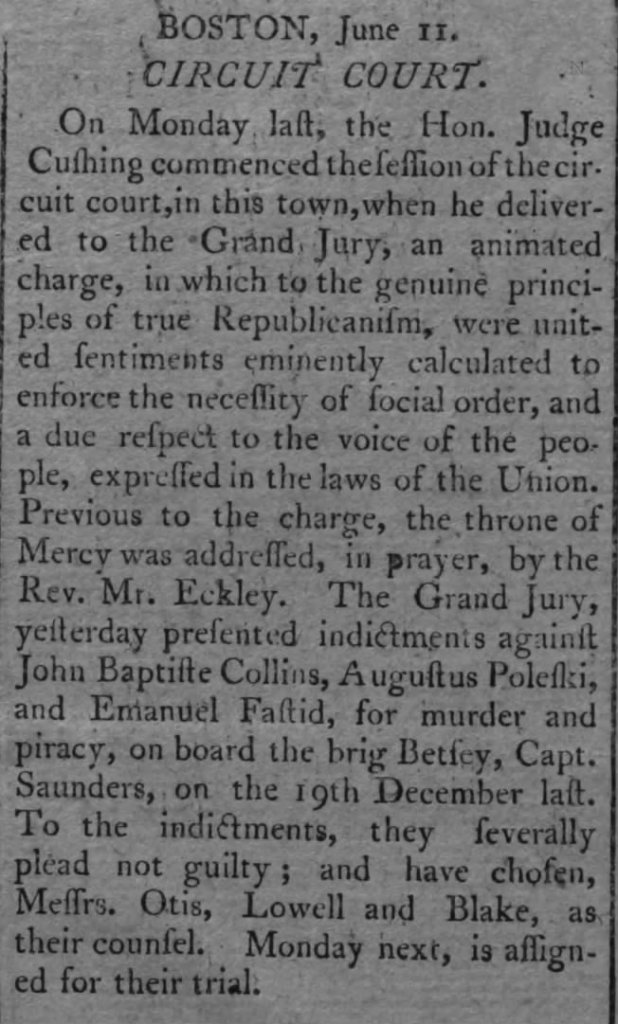
On November 3, 1793, Captain Joseph Saunders sailed the brig Betsy from Bilbao, Spain en route to Boston. Strong storms forced a change in course, leading the ship into the West Indies.
There on December 19, 1793, three crew members – John Baptiste Collins, Emanuel Fastidi, and Augustus Poleski – attacked Saunders, his mate, and a passenger, Enoch Wood, while they slept. Saunders and his mate survived; Wood was killed. The pirates then proceeded to attack the remaining crew and take control of the ship.
Several days later, with the ship under the control of the pirates and Saunders being held captive, another ship approached. Saunders was able to signal the need for help. After sailors from the other ship boarded, Saunders was able to make them aware of the situation and the pirates were captured.
Philadelphia Inquirer, June 16, 1794
The captured men were returned to Boston in March 1794 and placed on trial. In the U.S. Circuit Court in Boston, the three men were found guilty of murder and piracy on June 16 and sentenced to death.
Aurora General Advertiser (Philadelphia), August 7, 1794
John Baptiste Collins, Emanuel Fastidi, and Augustus Poleski were hanged in Boston on July 30, 1794. A large crowd witnessed the spectacle.
John (Jean) Desfarges was captain of the schooner Bravo (Le Brave), part of famed Jean Lafitte’s fleet of pirate ships plying the Gulf of Mexico in the early 1800s. Robert Johnston served as his first mate. Sixteen other sailors – Peter Morel, Charles Dickinson, Louis Pierre, Gervin Conchal, John McGee, Louis Phillip, John Frickhart, John Cousins, Ephraim Tompkins, Isaac Tillet, Thomas Thompson, Laurence Pagas, Joseph Walker, Juan Rayner, Julian Seddoner, and William McClure – were also aboard.
Opposing the piracy and smuggling that were so active across the Gulf were U.S. Revenue Cutters, whose powers had been expanded by federal legislation – the Piracy Act of 1819 – enacted on March 3, 1819.
The Louisiana and Alabama were sleek, newly-commissioned Revenue Cutters designed to interdict smugglers. Among the first encounters of the Louisiana, in September 1819, was with Bravo near the Dry Tortugas in the eastern Gulf of Mexico.
After a gun battle, officers from Louisiana boarded Bravo and captured its crew. The Alabama assisted in the capture.
The crew of the Bravo were tried in the U.S. District Court for the District of Louisiana in New Orleans in November 1819. Desfarges was convicted of piracy on November 19. The other defendants were convicted of the same charges on November 22. All of the men were sentenced to death on December 30.
On April 3, 1820, President James Monroe issued death warrants for fifteen of the defendants. Death warrants for Desfarges and Johnston were issued later. One of the defendants – a fifteen-year old – was subsequently pardoned.
Amidst local sympathy for the defendants, there were several armed attempts to free them. Troop reinforcements were ordered to guard the jail.
John Desfarges and Robert Johnston were hanged aboard the Revenue Cutter Louisiana in the Mississippi River at New Orleans on May 25, 1820.
York (Pa.) Gazette, June 27, 1820
The other executions were first respited and then, on July 5, 1820, all of those sentenced to death were granted an open-ended reprieve. Between October 1820 and January 1822, the remaining defendants were pardoned.
Lafitte soon relocated his base of operations to Mexico, apparently in response to more aggressive American enforcement operations.
“Hanging Le Brave: U.S. Revenue Cutter Antipiratical Operations in the Gulf of Mexico, 1819” by William R. Wells provided valuable information about this case.
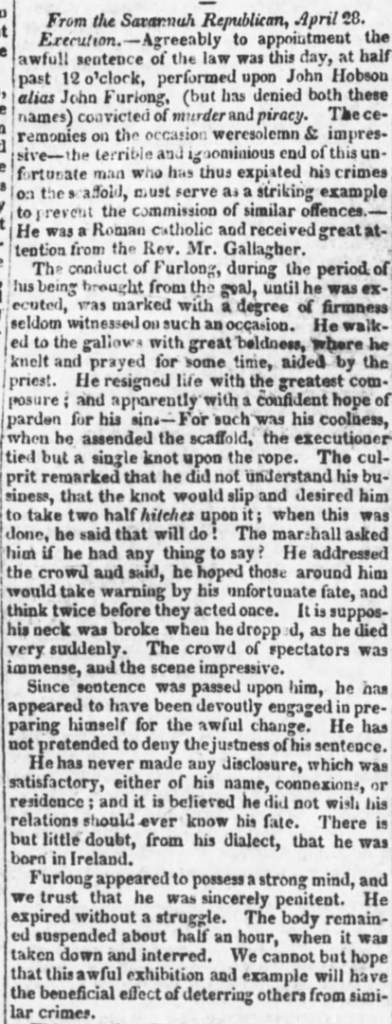
John Furlong (alias John Hobson) was a crew member of the sloop Lawrence when he and other crew members attacked and killed Captain Henley and First Mate May of the brig Ann.
Furlong and his accomplices were arrested in Savannah, Georgia, in August 1819.
New York Evening Post, August 16, 1819
John Furlong was tried in the U.S. Circuit Court of Georgia in Savannah and convicted of murder and piracy.
The United States Supreme Court reviewed the conviction to determine whether American law provided jurisdiction over foreign sailors on foreign ships in foreign waters. The Court determined that a vessel loses its national character when it engages in piracy, making it subject to United States law (United States v. Furlong, 18 U.S. 5 Wheat. 18, 1820).
John Furlong was hanged in Savannah on April 28, 1820.
Thomas Jones (alias John Robinson) was a Black sailor aboard the brig Holkar sailing from New York to Curacao in 1818. Trouble while in port led the captain to jail Jones and other crew member on the ship until they departed Curacao. After departing in January 1819, Jones and three other crew members sought revenge, killing Captain Samuel Brown, his mate, Henry Dulett, and a passenger, John Williams.
Soon after, another ship sailed nearby. Fearing detection, the men abandoned Holkar for a smaller boat they brought to shore in Jacquemel, Haiti. From there they made their way back to the United States as crew on other ships.
Five years later in New York City, Jones was identified by Oliver King, the one member of the crew of the Holkar who was not complicit in the murders.
Arrested, Thomas Jones was tried in the U.S Circuit Court in New York City and found guilty on May 3, 1824. King was the principal witness against him.
Long Island Star, May 27, 1824
Thomas Jones subsequently confessed. He was hanged in New York City on June 11, 1824.
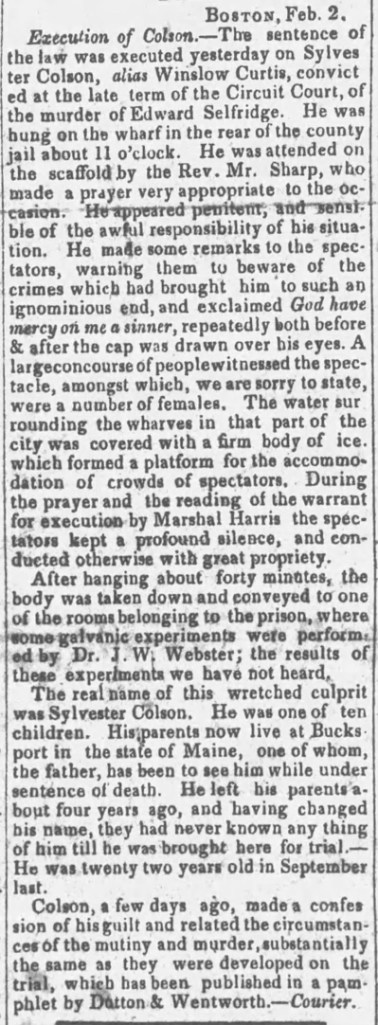
John Duncan White and Sylvester Colson (alias Winslow Curtis) were crew members aboard the Fairy as it sailed from Boston to Gothenburg (or Goteborg), Sweden in August 1826, carrying a cargo of coffee, rice, sugar, and tobacco.
Off the coast of Nova Scotia, White and Colson mutineed, killing Captain Edward Selfridge and his mate, Thomas Paine Jenkins, and throwing them overboard. Two other crew members were spared. They then sailed into Louisburg, Nova Scotia; White and Colson apparently trusting the other two crew members.
Once onshore, the two surviving men notified authorities. White and Colson were arrested and returned to Boston to stand trial.
In the Circuit Court of the United States in Boston on December 13, 1826, White, who was British, and Colson, who was a native of Maine, were tried separately for murder on the high seas. With White admitting to the crime, the two men were convicted and sentenced to death on December 23.
John Duncan White committed suicide on the eve of his execution.
United States Gazette, February 6, 1827
On the gallows, Sylvester Colson confessed to his role in the crime. He was hanged in the yard of the Leverett Street Prison in Boston on February 1, 1827
The Norfolk-based schooner J.B. Lyndsey was sailing from Trinidad to the Turks and Caicos Islands to take on a load of salt for delivery to North Carolina when, on January 27, 1850, when crew members Edward Clements and Thomas Reid attempted to commandeer the ship.
In the process, crews member John Walker and John Heeney were killed and the others, including Captain Solomon S. Riggs, were held captive. Clements and Reid then attempted to scuttle the ship and escape on a smaller boat.
As they did, one of the crew members aboard the J.B. Lyndsey was able to free himself and the surviving crew members and return to port. There, authorities issued an alert for Clements and Reid.
New Orleans Crescent, March 6, 1850
Once apprehended, Clements and Reid were returned to Virginia to stand trial. In the U.S. District Court in Richmond, they were tried and convicted of murder on the high seas in December 1850 and sentenced to death.
With their appeal to the U.S. Supreme Court pending, on September 30, 1851, the two men escaped from jail.
Arrested and returned to jail, the U.S. Supreme Court rejected their request for a new trial in February 1852.
Edward Clements and Thomas Reid were hanged together in the Henrico County Jail on April 23, 1852.
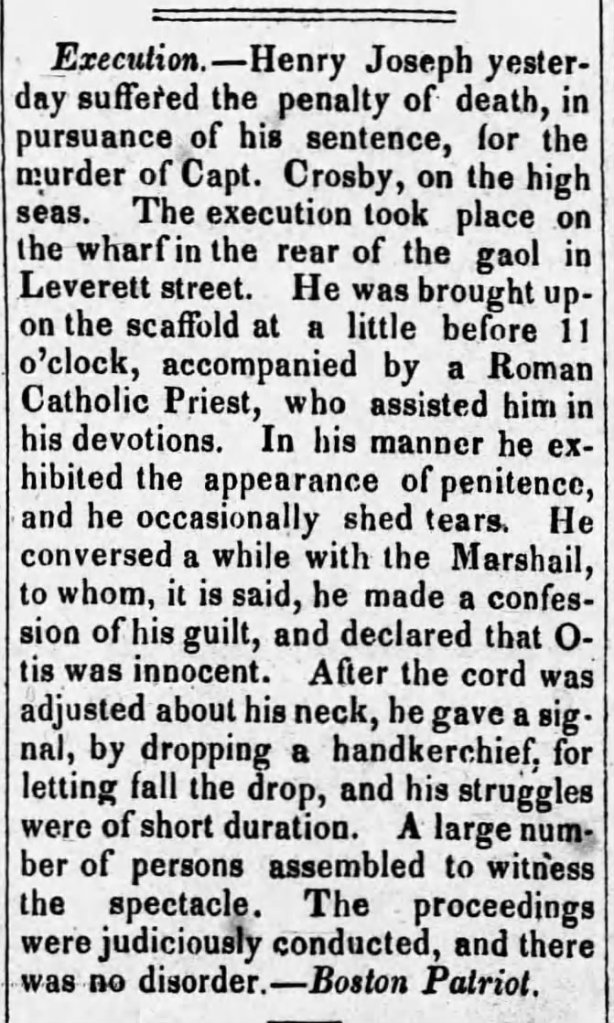
Henry Joseph, who was described as a Black man from the Spanish Main, worked as cook on the brig Juniper. Amos Otis, a white Englishman, worked as crew. En route from Boston to Suriname on August 14, 1834, Captain James Crosby and the first and second mates were killed.
Joseph, who by all reports attacked Crosby, was captured by the surviving crew and held until the ship was able to return to port. Otis, who was reported to have been in close contact with Joseph before the incident, was believed by the other crew to have conspired with him.
Joseph initially supported this view, claiming that Otis directed him to kill Crosby and the first and second mate and that Otis was supposed to kill the other crew members, allowing the two men to carry out their plan to pirate the ship to Havana.
At trial, Joseph told a different story, claiming that Captain Crosby had been abusive and that he acted on his own in planning and carrying out his revenge.
Both men were convicted of murder on the high seas and sentenced to death in the U.S. Circuit Court in Boston on November 1, 1834.
Henry Joseph was hanged in Boston before a large crowd on December 5, 1834. From the gallows, Joseph again confessed his guilt and Otis’s innocence.
Fall River (Massachusetts) Monitor, December 6, 1834
Amos Otis was pardoned by President Andrew Jackson on December 12 and released from prison.




 The Federal Death Penalty Project