Documenting and Analyzing the History of Federal Executions
Author: Bill Lofquist
I am a sociologist and death penalty scholar at the State University of New York at Geneseo. I am also a Pittsburgh native. My present research focuses on the history of the death penalty in Allegheny County (Pittsburgh), Pa.
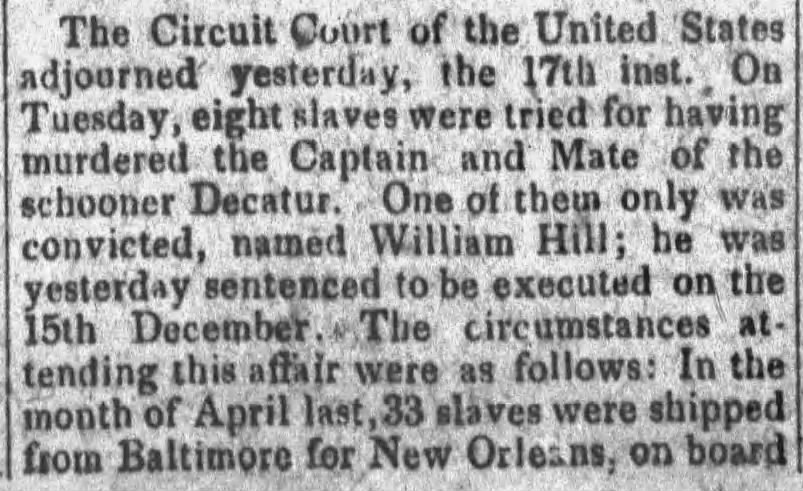
In April 1825, the Decatur left Baltimore for New Orleans carrying 33 enslaved people being sold south. En route, William Hill and other enslaved men overtook Captain Galloway and his mate, throwing them overboard.
The Decatur then sailed for Saint Domingue (present-day Haiti) and the promise of freedom. However, the untrained sailors had trouble navigating the ship. The Constellation, passing nearby, rendered aid, removing the women and children from the ship. The next day, another ship, the Rook, removed the remaining men from the ship and brought them to New York.
United States Gazette (Philadelphia), November 21, 1826
At trial in U.S. Circuit Court in New York on November 17, 1826, Hill was the only one of the eight men to be convicted. He was sentenced to death on November 20 and hanged on Ellis Island on December 15, 1826.
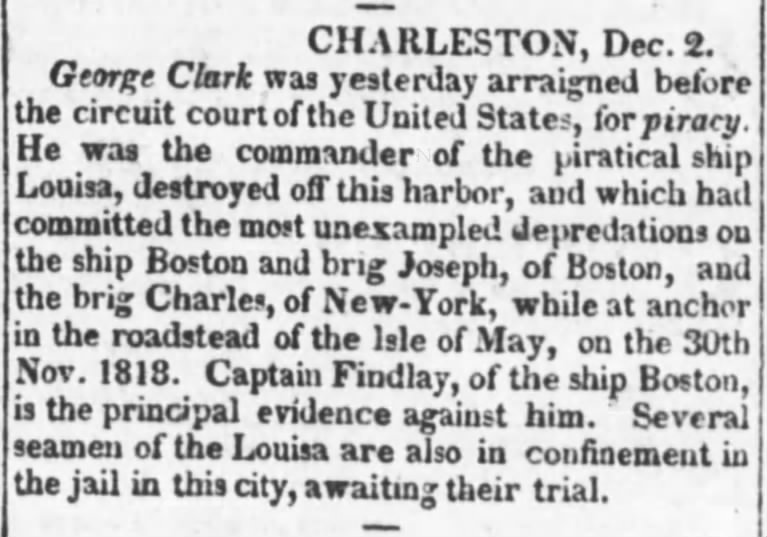
George Clark was the captain of the piratical ship Louisa when it attacked several ships at anchor off the Isle of May in Scotland on November 30, 1818.
New York Evening Post, December 10, 1819
At trial in federal court in Charleston, South Carolina, Clark was sentenced to death on March 21, 1820. Henry Roberts received the same sentence. Two other crew members, John Jones and Benjamin Bradsford, were likewise sentenced to death but recommended to mercy.
George Clark and Henry Roberts were hanged together in Charleston on May 12, 1820.
On March 24, 1819, John Ferguson and James Black, sailors in a time and place where sovereign boundaries and the associated statuses of sailing ships were often unclear, led a mutiny aboard the Creola, a ship aligned with the government of Buenos Aires, off the coast of Venezuela.
They then raided the Irresistible, a well-equipped warship aligned with the opposing forces of the United Provinces of River Plate, where they incited another mutiny.
Having captured the Irresistible, Ferguson, as captain, Black, as first lieutenant, and second lieutenant Israel Denny, used it to plunder numerous other vessels. No violence is reported to have occurred during any of these assaults.
Whether the sailors understood themselves as pirates seeking private gain or as privateers acting in service to a government became a matter of great dispute and consequence in subsequent legal proceedings.
Approximately three months later, the Irresistible sailed up the Chesapeake Bay to Baltimore, home to some of the sailors. Whether the men believed they had reason to fear the law is unclear. However, they were quickly arrested.
John Ferguson was tried in U.S. District Court in Baltimore in November 1819. He was convicted and sentenced to death for piracy. Israel Denny’s prosecution the next month produced the same result.
Nineteen other sailors were tried on piracy charges in federal court in Richmond, Virginia.
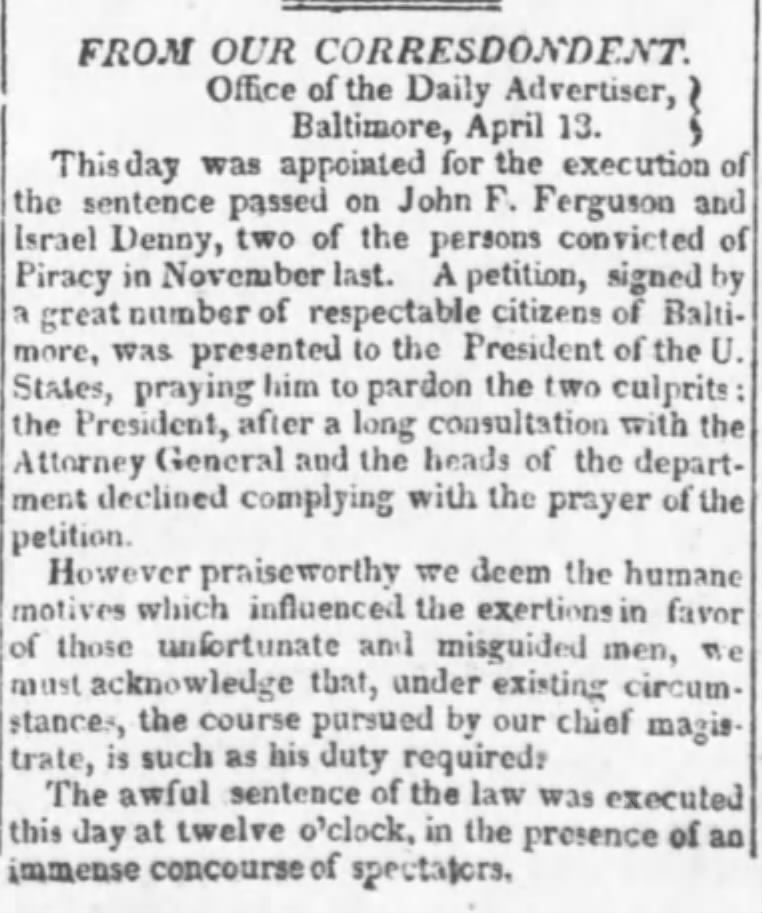
Efforts to obtain a pardon for Ferguson and Denny from President Monroe were unsuccessful, though public and political sentiment seemed to be moving against the death penalty for piracy.
While John Ferguson and Israel Denny went to their deaths, hanging together on April 13, 1820, the other sailors were spared in a landmark Supreme Court decision.
New York Evening Post, April 15, 1820
At issue in the Virginia case were three questions: had the sailors plundered other vessels?; had they done so without legal authority?; and did those actions constitute piracy? The jury found in the affirmative on the first two questions but arrived at a special verdict on the third question: that whether or not the plunder constituted piracy depended on the interpretation of the 1819 piracy statute.
This finding directed the case to the United States Supreme Court. In February 1820, the Supreme Court found that, under the 1819 statute, the conduct at issue clearly constituted piracy (U.S. v. Smith, 18 US 153).
At sentencing on May 29, 1820, all sixteen defendants were sentenced to be hanged on June 19, 1820. By that time, opposition to executions for piracy (not involving murder) had grown stronger. The executions were reprieved.
See “The Full Story of United States v. Smith, America’s Most Important Piracy Case” by Joel H. Samuels. Penn State Journal of Law & International Affairs, 1, 2 (November 2012).
Jose Casares, Felix Barbeito, and Jose Morando, dubbed the Spanish pirates in newspaper accounts, were among the crew of the brig Crawford sailing from Matanzas, Cuba, to New York City.
French sailor Alexander Hardy, who had a long history of piracy, was also on board. With him he carried forged papers that showed him to be in command of the ship en route to Hamburg, Germany. While still in port, he enlisted the Spaniards to assist him in his scheme to seize the Crawford.
The ship left port on May 28, 1827. After their attempt to poison the crew failed, on June 3, the four men began a rampage through the ship, killing Captain Henry Brightman and eight of the crew.
The four men and the crew they retained to sail the ship docked in Virginia on June 12. One of the crew escaped and alerted authorities, whose arrival led Hardy to commit suicide. Casares, Barbeito, and Morando fled, but were apprehended.
Lancaster )Pa.) Intelligencer, July 31, 1827
The three men were tried for piracy in the U.S. Circuit Court in Richmond in July 1827. They were convicted on July 20 and sentenced to death. They were hanged together in Richmond on August 17, 1827.
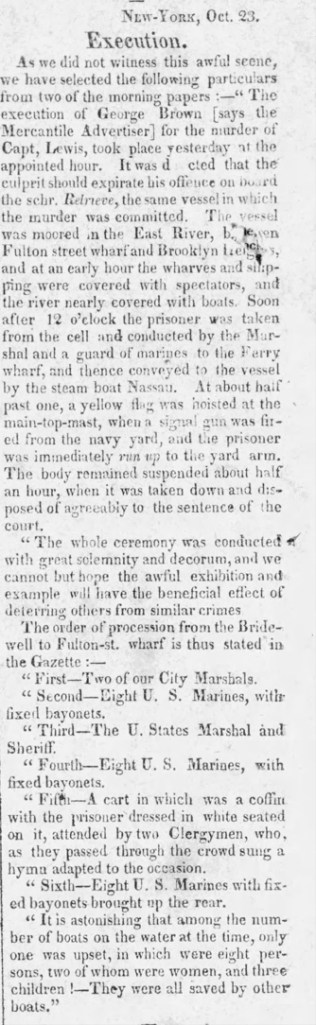
George Brown (given name William Tinsdale) served aboard the schooner Retrieve on its voyage from Cadiz, on the south coast of Spain, to New Orleans.
En route, Brown, Nicholas Palermo, and several other sailors mutineed, robbing and killing Captain Lewis and taking control of the ship. They sailed into Omoa, on the Spanish Main (present-day Honduras). While there, one of the crew members reported the crime, leading to their arrest.
The mutineers were transported to New York City aboard the USS Enterprise. While awaiting trial, one unidentified defendant died in jail.
Palermo agreed to testify against Brown. After a four-hour trial, Brown was convicted of murder on the high seas on September 6, 1819, and sentenced to death.
George Brown was hanged onboard the Retrieve anchored amidst numerous boats carrying onlookers in the East River on October 22, 1819.
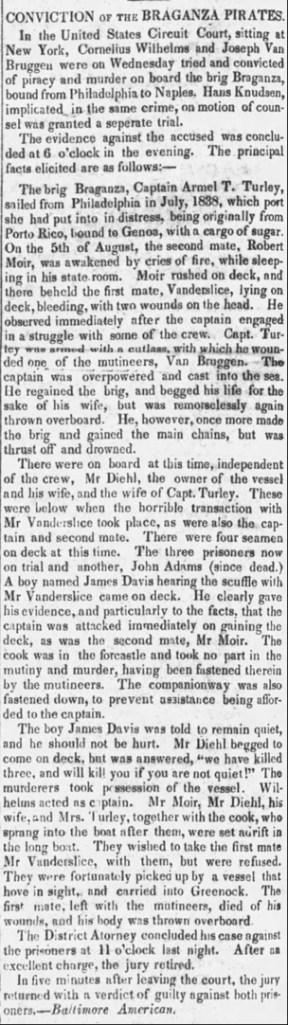
Cornelius Wilhelms and Joseph Verbruggen served as crew aboard the Braganza as it sailed from Philadelphia to Genoa, Italy with a cargo of sugar, in the summer of 1838.
On August 5, they, along with fellow sailors John Adams and Hans Knudsen, killed Captain Armer F. Turley and threw him overboard in an attempt to take control of the ship. They then boarded the remaining crew on a long boat and set them adrift and sailed themselves into port in northern Europe. Word of the mutiny had already reached there and they were arrested.
John Adams hanged himself in prison before he could stand trial.
At trial in U.S. District Court in New York City on 1, May 1839, Wilhelms, who was Dutch, was convicted of murder on the high seas and sentenced to death. The Belgian Verbruggen was also convicted and sentenced to death. Knudsen was tried and acquitted the next day.
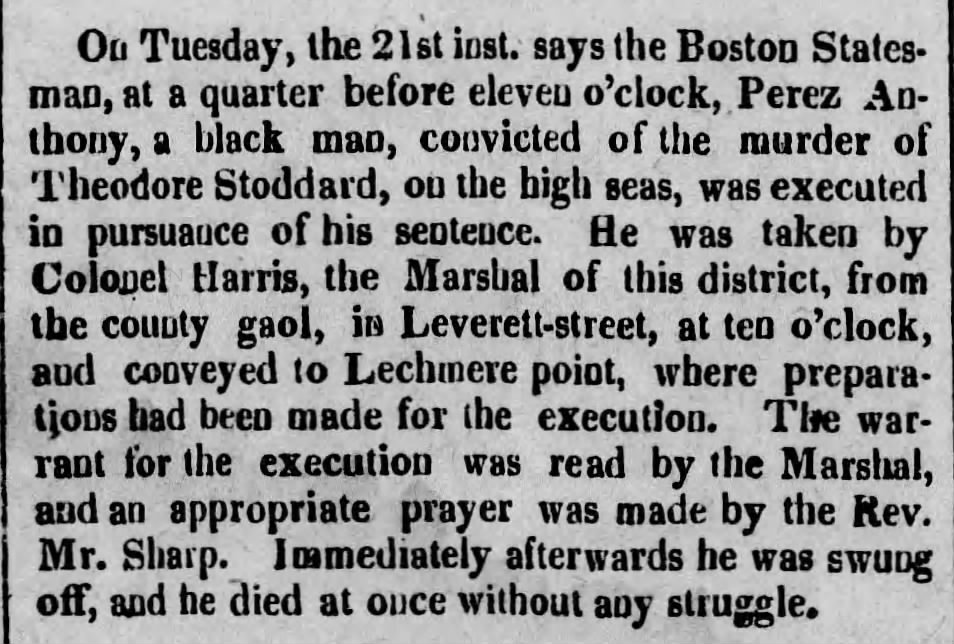
Kentucky Gazxette, May 16, 1839
Joseph Verbruggen hanged himself in jail on May 4. Cornelius Wilhelms was hanged on Bedloe’s Island – present-day Liberty Island – in New York Harbor on June 21, 1839.
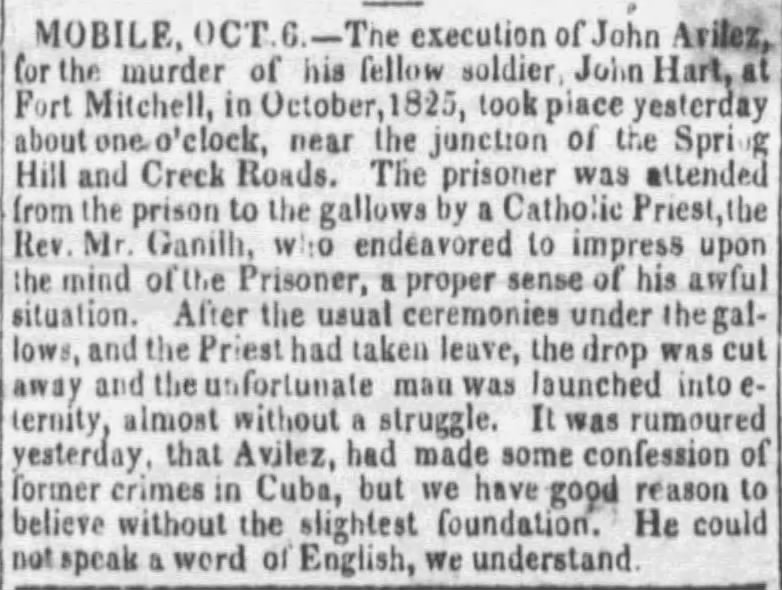
John Avilez, a soldier stationed at Fort Mitchell, Alabama, killed fellow soldier, John Hart, in October 1825. The killing took place in Indian Territory, resulting in federal jurisdiction.
Avilez, who apparently was Cuban or Spanish, was described as unable to speak English.
He was convicted of murder in U.S. District Court in the spring of 1827 and sentenced to death on May 16, 1827. On appeal, he argued that a recent act of the Alabama state legislature gave the state jurisdiction over the case. The court rejected that argument.
John Avilez was hanged in Mobile, Alabama, on October 5, 1827.
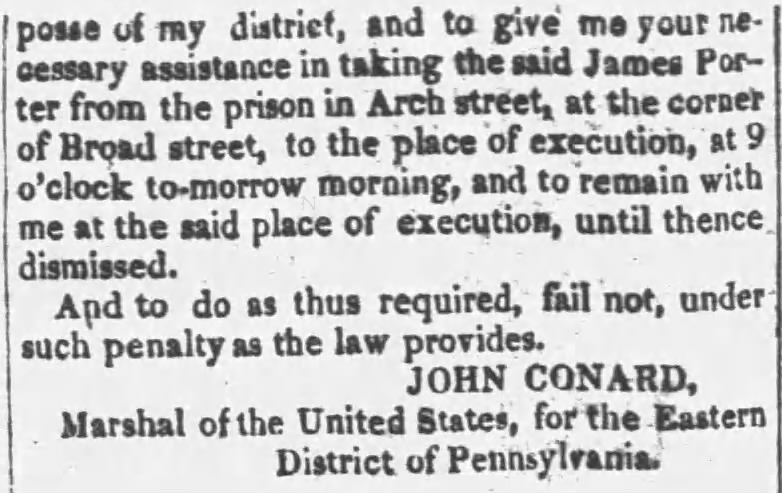
James Porter (alias James May), Abraham Poteet, and George Wilson worked as highwaymen in the area around Philadelphia in the late 1820s. After being arrested in February 1830, Poteet and Wilson confessed to robbing travelers in November 1829, robbing the Washington to Philadelphia mail the same month, and robbing the mail en route from Philadelphia to Reading a month later, and implicated Porter. A non-fatal shooting occurred as part of the first robbery.
Gettysburg Compiler, February 16, 1830
Based on that information, Porter was arrested on February 27, 1830.
After being convicted of mail robbery and sentenced to death in federal court in Philadelphia, Porter was hanged on July 2, 1830.
Wilson’s death sentence was commuted to life imprisonment.
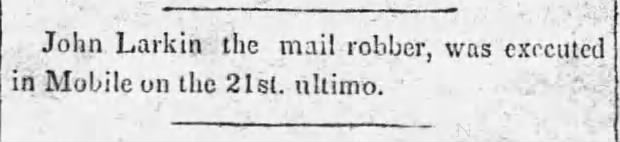
On January 19, 1838, John Larkin robbed the mail and killed the driver in Stockton, Alabama. When he was arrested months later in Philadelphia, he was found carrying papers that implicated him in the crimes.
Returned to Mobile, Alabama to strand trial, Larkin escaped from jail in March 1839. Recaptured, he was tried and convicted in April 1839 and sentenced to death.








 The Federal Death Penalty Project