Documenting and Analyzing the History of Federal Executions
Author: Bill Lofquist
I am a sociologist and death penalty scholar at the State University of New York at Geneseo. I am also a Pittsburgh native. My present research focuses on the history of the death penalty in Allegheny County (Pittsburgh), Pa.
Moore was a 28-year old from Missouri who had, the previous year, stolen from cattle from a man in Arkansas. Chased by the man’s neighbors, he fled into Indian Territory. The search for him was joined by Captain Irwin, a former U.S. marshal, and John Spivey.
When the search party closed in on Moore, he opened fire, killing Spivey and wounding Irwin. Moore was captured and jailed in October 1874.
On trial before Judge Parker, he was convicted and sentenced to death. Along with five other men convicted of unrelated murders, James Moore was hanged on September 3, 1875.
Campbell was a 20-year old Black man raised in the Choctaw Nation in the southeastern corner of Indian Territory. North of there in the Cherokee Nation on February 18, 1875, Campbell and his younger brother, Sam, and half-brother, Frank Butler, killed Lawson Ross and a young girl.
The murder was in retaliation a wrong done to Campbell’s parents by Ross.
St. Louis Globe-Democrat, July 15, 1875
At trial before Judge Parker, Edmund Campbell and Butler were found guilty. Prior to sentencing, Butler was killed while trying to escape. Campbell was sentenced to death.
Along with five other men, each sentenced to death for a separate murder, Edmund Campbell was hanged on September 3, 1875.
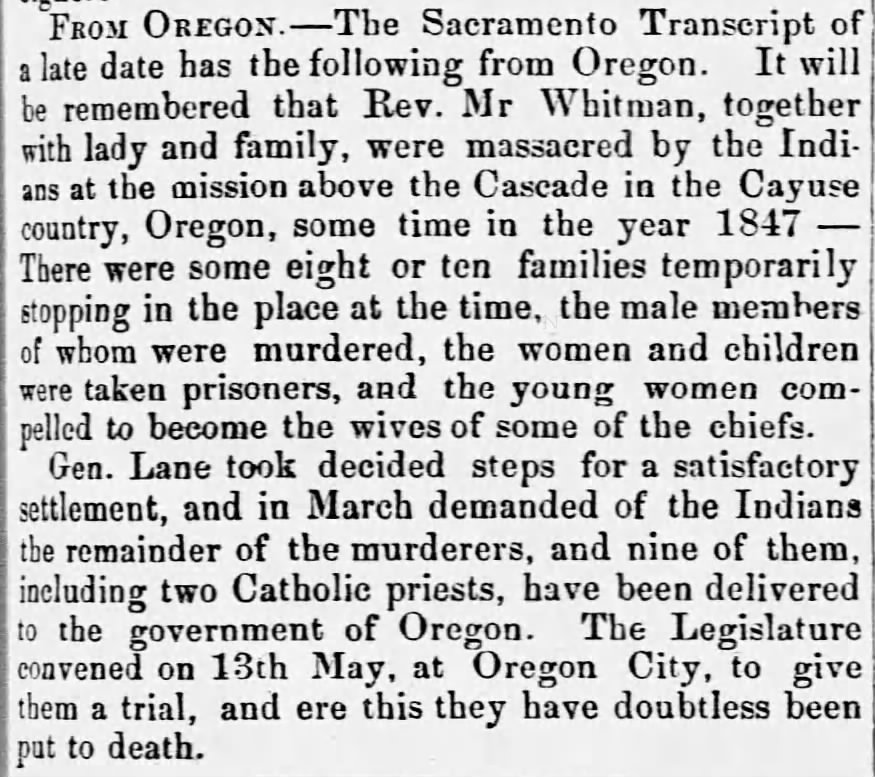
As white settlers poured into the Oregon Country in the 1830s and 1840s, the Cayuse and Umatilla tribes were increasingly threatened. What began as small scale missionary work came to be seen by Native groups as increasingly threatening and coercive. Violent incidents between the groups increased. Lethal outbreaks of disease spread among the Natives.
In response to these incursions, on November 29, 1847, the Cayuse attacked a party of seventy-two settlers, killing thirteen, including their leader, Marcus Whitman, and holding the rest captive for weeks in exchange for goods.
As white settlers gained power and claimed sovereignty over the territory, which was organized and recognized by Congress as the Oregon Territory in 1848, their demands that the Cayuse be held legally responsible for the Whitman Massacre intensified. Cayuse efforts to characterize the incident as an act of war and to note their own losses were rejected.
Eventually, five Cayuse men – Tiloukaikt, Tomahas, Kiamasumpkin, Iaiachalakis, and Klokomas – were turned over for trial. The legal proceedings were conducted in a tavern with minimal due process protections.
U.S. Attorney Amory Holbrook tried the men before federal judge Orville C. Pratt in Oregon City, Oregon. After a lengthy and controversial trial, in which the defense emphasized the lack of federal jurisdiction over the case at the time of the killings, all five men were found guilty and sentenced to death.
Vermont Journal, July 12, 1850
Their hanging, on June 3, 1850, on a gallows constructed in Oregon City, was organized by U.S. Marshal Joseph L. Meek, whose daughter died while being held captive by the Cayuse.
Five years later, the Cayuse were forced on to the Umatilla Reservation.
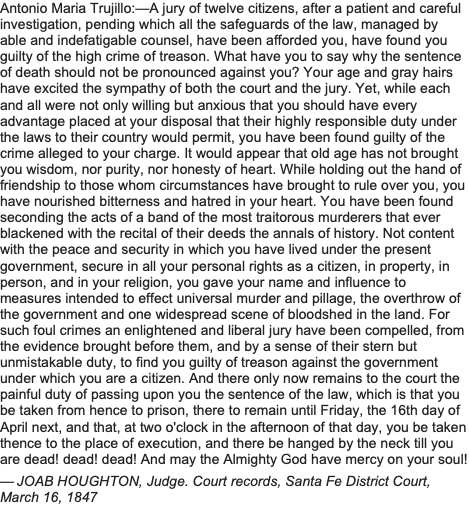
In the midst of the Mexican-American War (1846-1848), when the border between the United States and Mexico and the sovereign status of New Mexico were being contested, Antonio Trujillo, an American citizen, was a Mexican military official operating north of the Rio Grande River.
In events known as the Taos Revolt, Mexico directed Trujillo to issue orders for Mexicans to take up arms against the United States. When he did, his role became treasonous.
Trujillo was arrested. On March 16, 1847, he was tried for treason in U.S. District Court, found guilty, and sentenced to death.
After the Supreme Court affirmed his conviction and President Polk declined to intervene, Trujillo was hanged in Santa Fe on April 16, 1847.
By the 1960s, use of the death penalty was declining sharply across the United States. Growing questions about the fairness of its use, particularly in the context of the Civil Rights Movement, had slowed the machinery of death in anticipation of Supreme Court review.
After eight federal executions in the 1950s, only one would occur in the 1960s, and that would be the last federal execution for nearly 40 years – until Timothy McVeigh was executed in 2001.
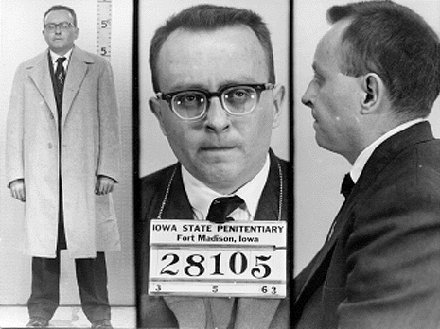
Victor Feguer was a solitary drifter. He arrived in Dubuque, Iowa in 1960 and took up residence in a boarding house. From there, he called doctors looking for one to make a house call. When Dr. Edward Bartels arrived, Feguer kidnapped him, drove him to Illinois, and killed him. His motive was to obtain any drugs Bartles was carrying. It was July 11, 1960.
Feguer was arrested in Birmingham, Alabama, a few days later after he tried to sell Bartles’ car to James B. Alford without title papers, which led Alford to alert authorities.
Birmingham News, July 21, 1960
Because Feguer had crossed state lines in kidnapping and killing Bartles, federal charges were filed against him.
At trial, he was convicted and sentenced to death. His appeal was rejected, as was his clemency request to President Kennedy. Iowa Governor Harold Hughes, who opposed the death penalty, also appealed to Kennedy for commutation.
Victor Feguer
Victor Feguer was executed by hanging at the Iowa State Prison in Fort Madison on March 15, 1963.
Feguer’s was the first and last federal execution in Iowa. He was also the last person executed in Iowa, which abolished the death penalty in 1965.
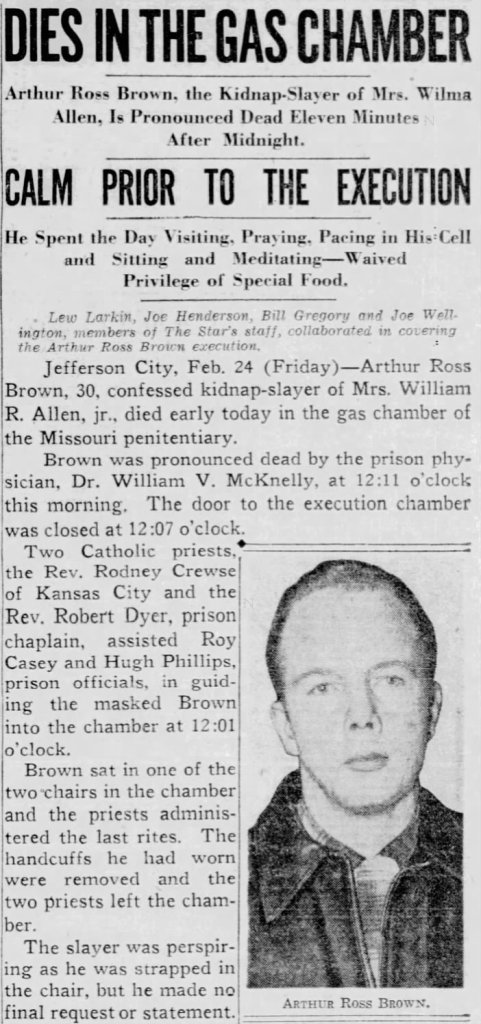
Arthur Ross Brown had a long criminal record and was in the midst of a crime spree when he kidnapped, raped, robbed, and murdered Mrs. Wilma Allen, the wife of a prominent Kansas City auto dealer, on August 4, 1955. Allen was murdered in Kansas, across the border from where she was abducted.
Brown had arrived in Missouri, home of his ex-wife and daughter, the previous day. He had been in Wyoming, where he had shot a police officer. On August 4, he decided to commit a robbery and selected Allen as his victim because she looked wealthy.
Brown fled after the killing. Wilma Allen’s body was found in a Kansas field on August 8. Local police and FBI officials were unable to develop leads in the case, which remained unsolved for months.
On November 14, Brown was arrested in San Francisco on separate charges. Once in custody, he confessed to killing Allen. Later that month, he was charged in federal court with Lindbergh Act violations, which made this a capital case.
Brown’s trial in federal district court in Kansas City began on January 23, 1956. He was prosecuted by United States District Attorney Edward Scheufler, who had convicted Hall and Heady on similar charges two years earlier. Brown was convicted two days later and sentenced to death.
Arthur Ross Brown was executed in the gas chamber at Missouri State Prison in Jefferson City on February 24, 1956.
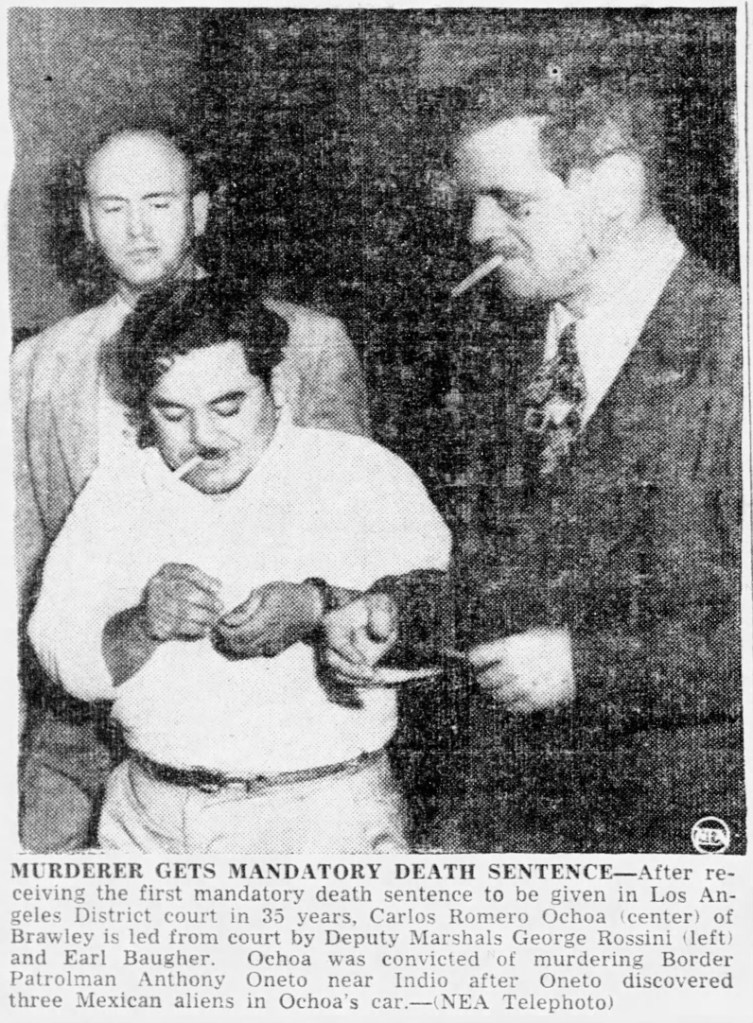
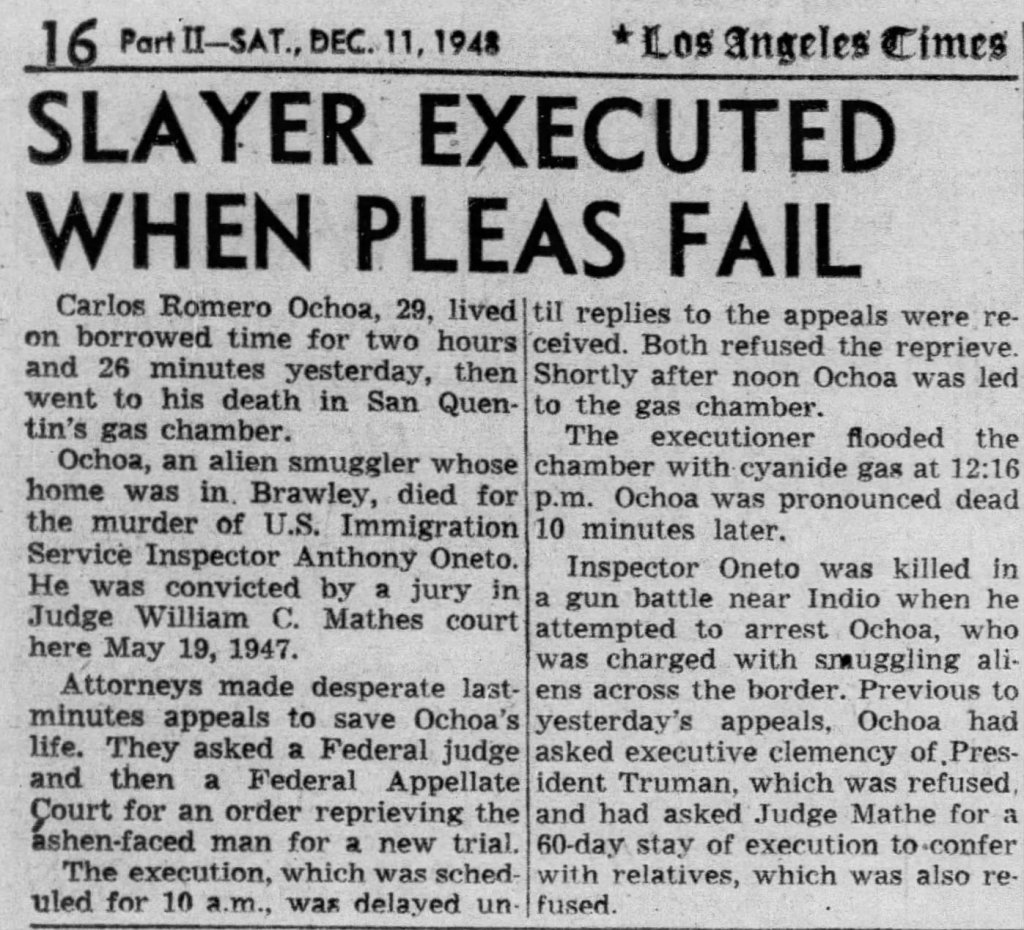
On March 11, 1947, two United States Immigration Service officers were patrolling the Mexican border region in the Mojave Desert near Indio, California, when they stopped a vehicle driven by Carlos Ochoa and carrying three Mexican nationals. The three Mexicans were transferred to the officers’ vehicle and Ochoa was directed to drive his car, with the officers following, to Indio.
As the two vehicles traveled, Ochoa feigned car problems and pulled over. When the officers came to his aid, he pulled a gun and shot and killed Officer Anthony Oneto and wounded Officer John Foquette.
Ochoa was on probation for human smuggling at the time of the murder.
At trial in the United States District Court for the Southern District of California, Ochoa admitted committing the murder and claimed insanity. He was convicted and sentenced to death.
Visalia Times, May 21, 1947
Ochoa’s conviction was affirmed on appeal and he was executed in the gas chamber at San Quentin State Prison on December 10, 1948.
On June 30, 1943, Henry Ruhl, a transient farm worker who had absconded from parole in Washington, robbed and murdered Matt Katmo, a defense production worker, on a military reservation near Laramie, Wyoming. Katmo and a date were picnicking in the Telephone Canyon area when Ruhl demanded Katmo’s car and killed him when he resisted.
Ruhl was tried in the United States District Court for the District of Wyoming. He was convicted of first degree murder on May 26, 1944, and sentenced to death on June 30, 1944.
Casper Star-Tribune, April 27, 1945
After his conviction was upheld on appeal, Henry Ruhl was executed in the gas chamber of the Wyoming State Penitentiary on April 27, 1945.
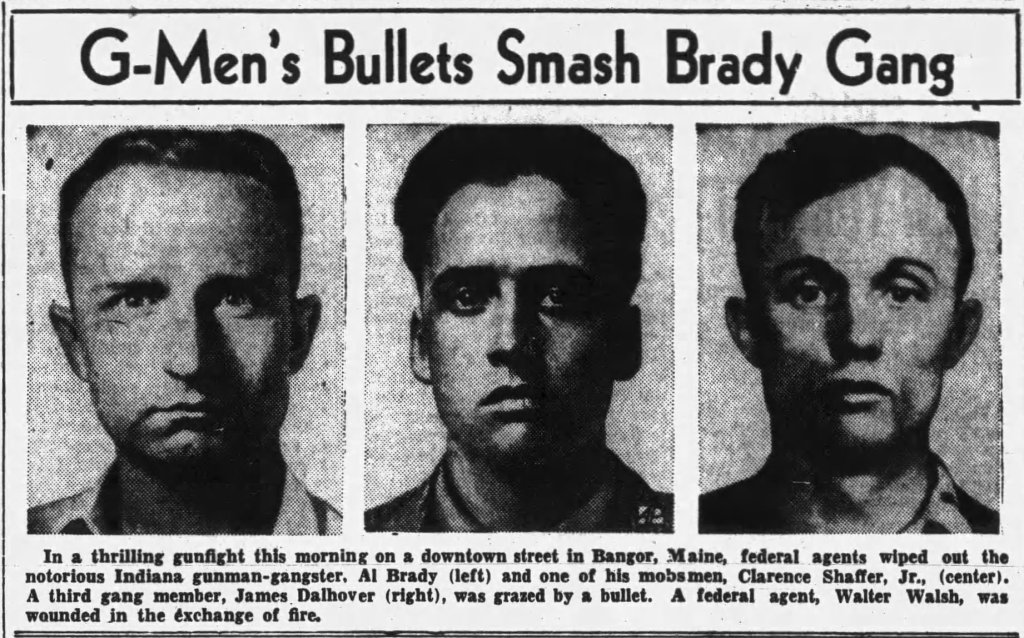
Alfred Brady, James Dalhover, and Clarence Lee Shaffer, Jr. formed the Brady Gang, one of the most notorious gangs of the notorious outlaw era of the 1930s. In the months between late 1935 and April 1936, the gang was believed to have committed as many as 150 robberies and at least one murder.
The men were finally apprehended in May 1936, albeit temporarily. Brady, Dalhover, and Shaffer escaped from the Hancock (Indiana) County Jail on October 11, 1936.
They headed east to Baltimore, committing crimes in Ohio and West Virginia on the way. Living in Baltimore, they returned periodically to the midwest to commit robberies.
On one of those trips on May 25, 1937, they robbed the Goodland State Bank in Goodland, Indiana, and killed Indiana State Police Officer Paul Minneman.
On a trip to Bangor, Maine, to buy guns in October 1937, a store clerk alerted police to their presence. After the gang made plans to return to the area to pick up a large cache of guns they had purchased, police were able to plan their capture.
When they returned on October 12, police were waiting. Dalhover entered the store and was promptly arrested. Brady and Shaffer were killed by police as they waited outside the store.
Herald-Press (Saint Joseph, Michigan), October 12, 1937
Dalhover was charged with Minneman’s murder. At trial in the United States District Court for the Northern District of Indiana, he was convicted and sentenced to death. After his appeal failed, James Dalhover was executed in the electric chair at the Indiana State Prison in Michigan City, Indiana, on November 18, 1938.
On September 25, 1937, retired Chicago executive Charles Sherman Ross and his friend and former secretary, Florence Freihage, were driving to Ross’s home when their car was forced to stop by another motorist. As they came to a stop, John Henry Seadlund rushed to their car with a gun drawn. He took Ross from his car, leaving Freihage behind, returned to the trailing car driven by James Atwood Gray, and sped off.
Gray, Seadlund, and their captive fled into Wisconsin and then to a remote wooded area near Emily, Minnesota. From there, they began an elaborate series of ransom communications with Ross’s family.
On October 8, $50,000 ransom was paid. Two days later, Seadlund shot and killed Gray and Ross in Wisconsin and buried them. He then traveled west. Subsequent investigation found that over the next three months, Seadlund traveled around the country.
On October 19, Ross’s wife contacted law enforcement, who were heretofore unaware of the crime. The FBI traced the ransom money to the Santa Anita racetrack in California. A sting set up there led to Seadlund’s arrest on January 14, 1938.
Seadlund, who had a lengthy criminal record, provided a full confession on January 17. He pleaded guilty to a violation of the federal kidnapping statute on February 28, 1938. He was found guilty and sentenced to death on March 16, 1938.
His appeal was subsequently rejected and John Henry Seadlund was executed in the electric chair in Chicago on July 14, 1938.






 The Federal Death Penalty Project