Arthur Gooch

Arthur Gooch and Ambrose Nix were on the run in Texas after escaping from jail in Holdenville, Oklahoma, in 1934.
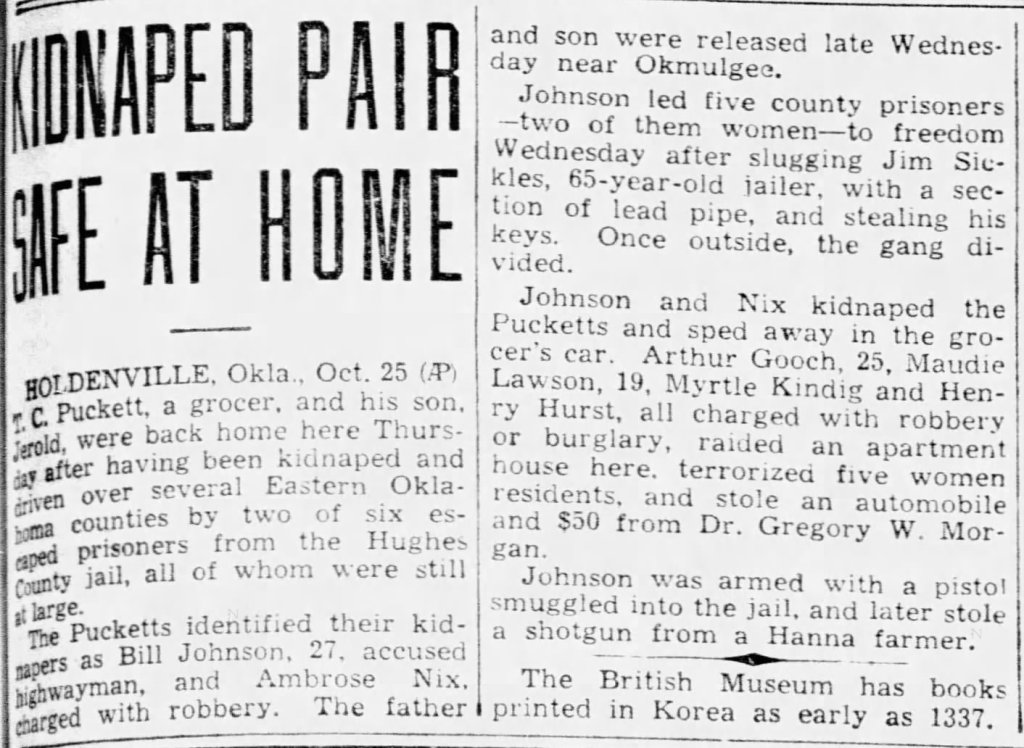
Fort Worth Star Telegraph, October 24, 1934

In Tyler, Texas, on November 25, 1934, the two men committed a robbery. Approached by police the next day, the pair forced the two police officers back in to their patrol car and fled with them into Oklahoma.

Brownsville Herald, November 27, 1934

The officers were released unharmed in Oklahoma. No matter. The Lindbergh Law, enacted in the wake of the sensational kidnapping of the famed aviator’s son in 1932, had been violated. The law made kidnapping a federal capital offense, even in the absence of murder.

Gooch and Nix were apprehended in Oklahoma in December, 1934. Nix was killed while being arrested.

Arthur Gooch was executed by hanging in Oklahoma on June 19, 1936. His was the only federal execution for kidnapping that did not involve murder.

Arthur Gooch on the gallows

Earl Gardner

Earl Gardner was an Apache living on the San Carlos Reservation in Arizona, when he killed his wife, Alice, and son, Edward, on December 8, 1935. Gardner, who was abusive toward his wife, had a long history of violence, including a seven year federal prison sentence for killing a man in 1925.

Arizona Daily Star, December 9, 1935

At trial in federal court in Globe, Gardner was convicted and sentenced to death on February 6, 1936. He had pleaded guilty and requested to be executed. A trial the previous month ended with a hung jury.

Earl Gardner was hanged near Globe, Arizona, on July 12, 1936. As with the execution of George Sujynamie eleven years earlier, concern about Native American unrest led Arizona officials to deny the U.S. Marshal Service’s request to use the state prison for the execution.

Arizona Republic, July 13, 1936

The hanging was badly botched, with Gardner slowly asphyxiating before dying. The subsequent outcry led to a change in federal law that eliminated hangings and directed instead that the method of execution would follow whatever method was used in the state.

It was the last legal hanging in Arizona history.

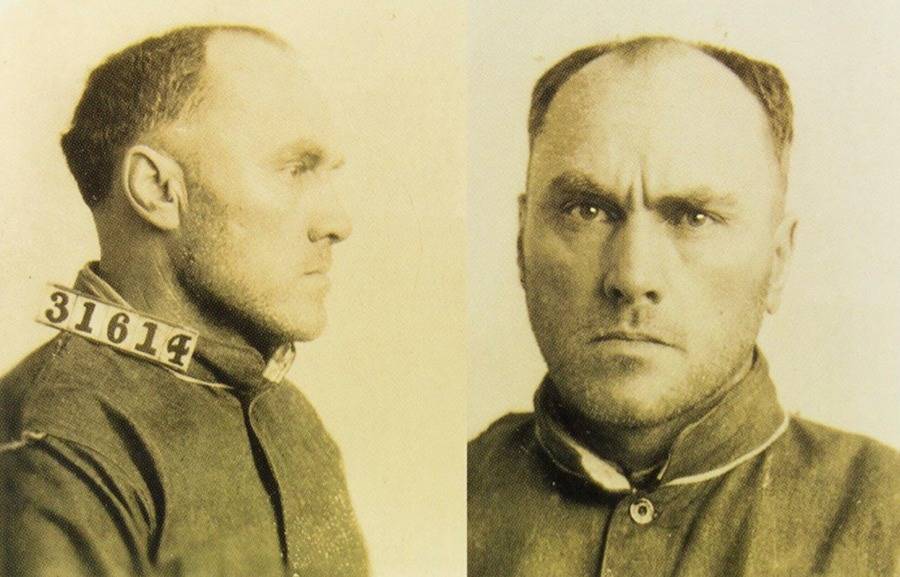
Charles “Carl” Panzram

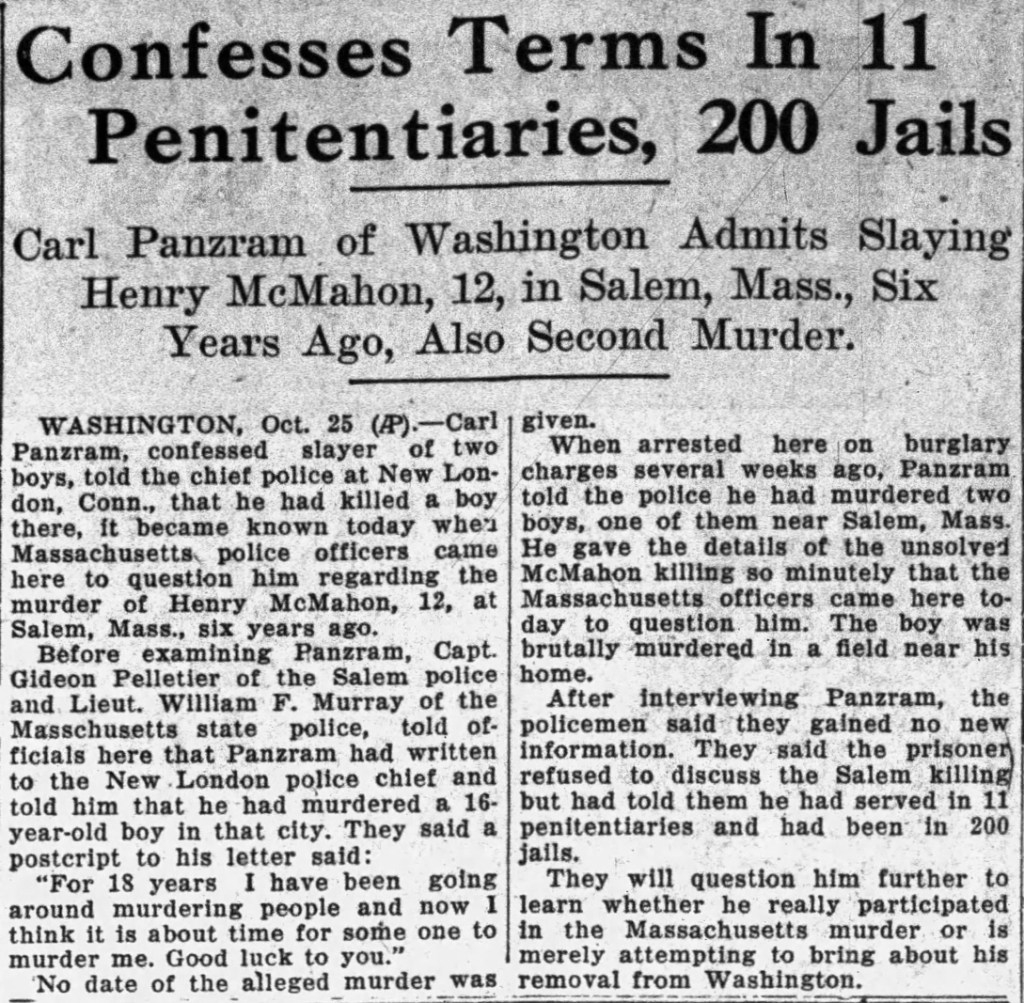
Carl Panzram was a serial rapist and murderer who ended his long and sordid criminal career by killing a federal prison guard. For that murder, he was executed.

Growing up in Minnesota, Panzram was involved in petty crimes. While at the Minnesota State Training School, he was repeatedly beaten and raped by staff members. Once released, his delinquency and, later, criminality continued. By the time he reached adulthood, he was moving from state to state and cycling in and out of prison for a wide variety of increasingly serious crimes.

Panzram later claimed that his murder spree began around 1920, when he started raping and killing boys and young men along the East Coast as well as while working on an oil rig in Angola, Africa.

Rutland (Vermont) Daily Herald, October 26, 1928

The events that culminated in Panzram’s execution began in August 1928, when he was arrested in Baltimore, Maryland, for burglary. Once in custody, he confessed to multiple murders. He was ultimately sentenced to 25 years to life at Leavenworth Federal Penitentiary.

Apparently determined to bring about his own execution, Panzram killed prison employee Robert Warnke on June 20, 1929.

Sentenced to death, Carl Panzram was hanged on September 5, 1930, at Leavenworth.

His life, crimes, and execution have been the subject of several books and a movie.

James Horace Alderman

James Alderman was a prolific rum runner, smuggling alcohol into Florida from Cuba and the Bahamas during Prohibition.

He and his associate, Robert Weech, were intercepted by a Coast Guard ship as they returned from Bimini on August 7, 1927. During the effort to arrest them, Alderman and Weech killed Coast Guardsmen Sidney Sanderlin and Victor Lamby and Internal Revenue Agent Robert K. Webster.

Weech cooperated with authorities and testified against Alderman in return for a lesser sentence. Alderman was sentenced to death by U.S. District Judge Henry Clayton in January 1928. After unsuccessful appeals and clemency efforts, he was hanged on August 17, 1929, at the Coast Guard base near Fort Lauderdale.

George Dixon Sujynamie

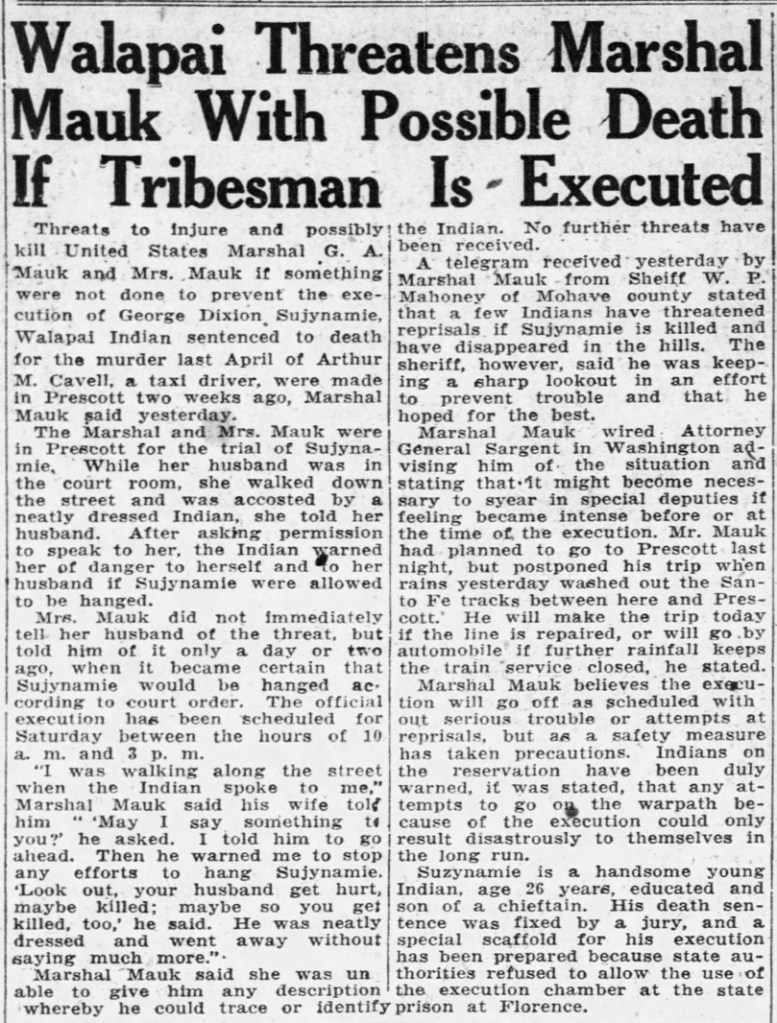
George Sujynamie, a 19-year old Hualapai tribe member, was arrested for the murder of Arthur M. Cavell, a white taxi driver, who was beaten to death in April 1925, on the Fort Whipple Reservation, near Prescott, Arizona. Sujynamie then stole Cavell’s taxi. He was arrested hours after the killing.

Arizona Republic, April 22, 1925

Sujynamie later confessed that he killed Cavell so that he could use his car to acquire a gun to kill Minnie Carey, a woman with whom he was infatuated, and several others.

Arizona Republic, October 6, 1925

The execution occurred at the federal military facility near Prescott on October 10, 1925. Due to unrest related to the execution, Arizona officials denied the U.S. government the use of the gallows at the state prison.

Samuel Greenhill

Samuel Greenhill and David Dewberry were arrested and charged with the killing of Harry S. White, a guard at a federal nitrate facility in Muscle Shoals, Alabama. The killing of the white guard by the two Black men occurred on December 8, 1923, after White put the men in custody for hunting on federal property.

Birmingham News, August 6, 1925

Dewberry was convicted and sentenced to life imprisonment while Greenhill, determined to have fired the fatal shot, received a death sentence. After President Coolidge refused to intervene in the case, Greenhill was hanged in Florence, Alabama, on October 10, 1925.

Henry A. Brown

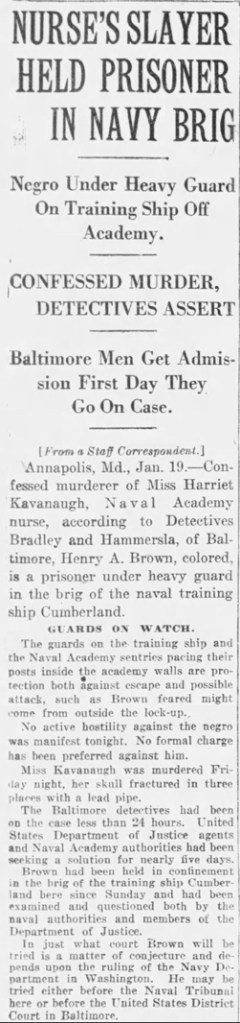
Harriet M. Kavanaugh was a nurse at the Naval Academy Hospital in Annapolis, Maryland, when she was robbed and badly beaten on January 14, 1921. She died the next day. The initial investigation focused on two white men.

Based on reports he had been seen near the hospital, Henry A. Brown, a Black, 19-year old Navy deserter, was arrested for her murder by Baltimore police on January 16.

Baltimore Sun, January 20, 1921

Brown initially denied any involvement in the case or any knowledge of the victim, though he had previously worked in the hospital. He later confessed, though he subsequently repudiated that confession as having been coerced. Even more dramatically, Brown stated that he was tortured by fellow sailors while being held prior to his confession.

His trial in the United States District Court in Baltimore began on March 28, 1921. Brown was convicted five days later and sentenced to death.

Despite protests and pleas for mercy from civil rights advocates, Henry Brown was hanged on September 1, 1921. The heightened level of racial animus at the time, the race and gender circumstances of the crime, and the details of the investigation raise serious questions about the integrity of Brown’s convictions.

John Williams, Francis Frederick, John Rog, and Peter Peterson

These four men were sailors aboard Plattsburgh, a Baltimore-based merchant schooner. On a voyage to Turkey that began in the summer of 1816, the four men were part of a group who killed Captain William Hatchett and sailors Thomas Baynard and William Gaison and absconded with the ship’s cargo.

They were apprehended in Denmark and returned to the United States to face trial in federal court in Boston.

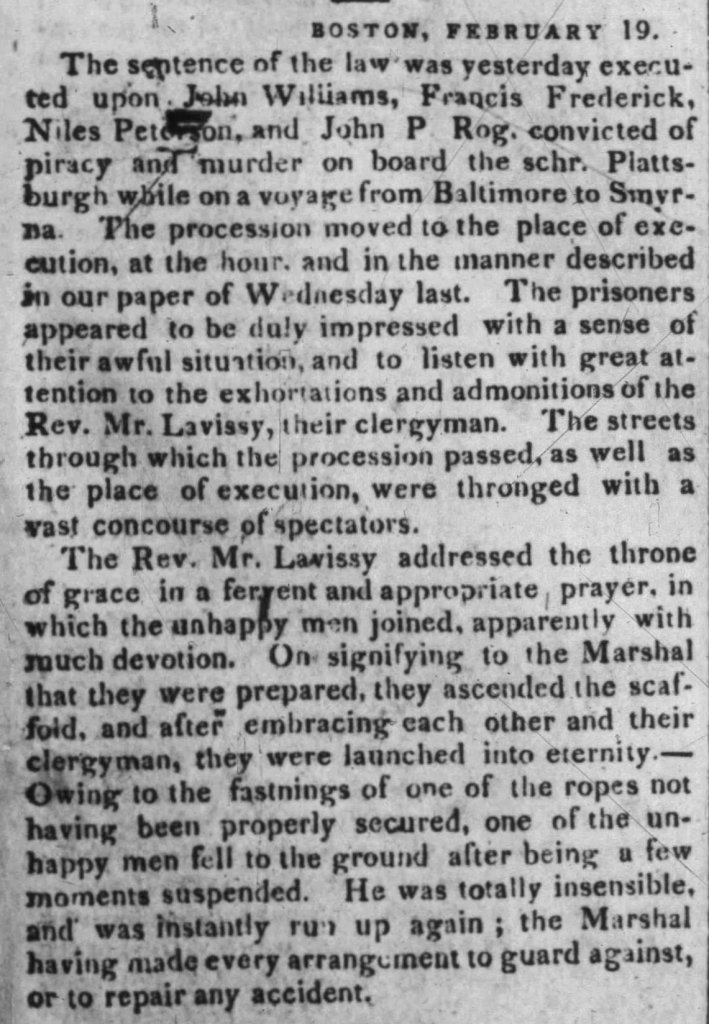
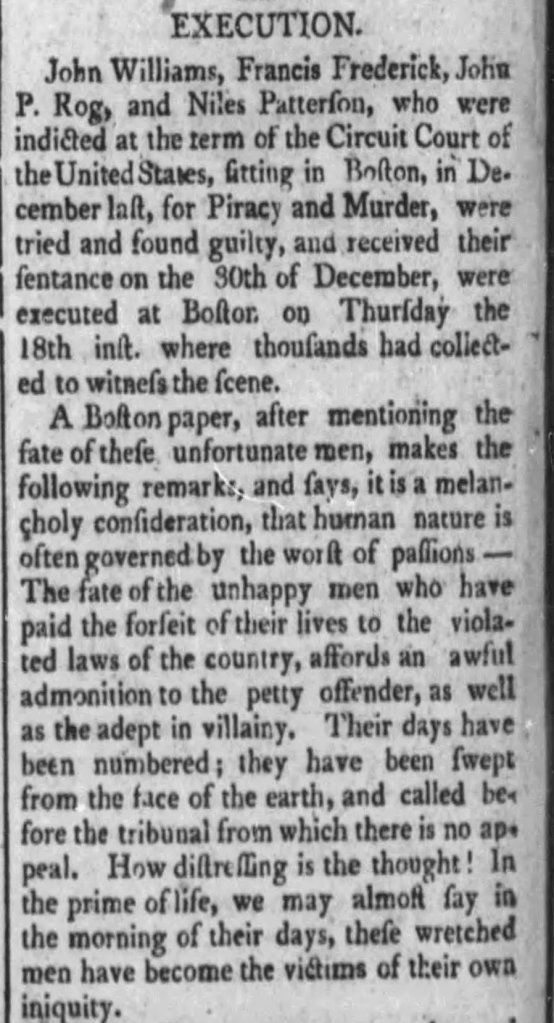
The men were convicted of murder and piracy on December 30, 1818, and sentenced to death on January 21, 1819.

Pittsfield (Massachisetts) Sun, February 24, 1819

John Williams, Francis Frederick, John Rog, and Peter Peterson were hanged together near Boston on February 18, 1819.

Sentinel and Democrat (Burlington, VT), February 26, 1819

See Niles Weekly Register, November 16, 1816

William Wyatt

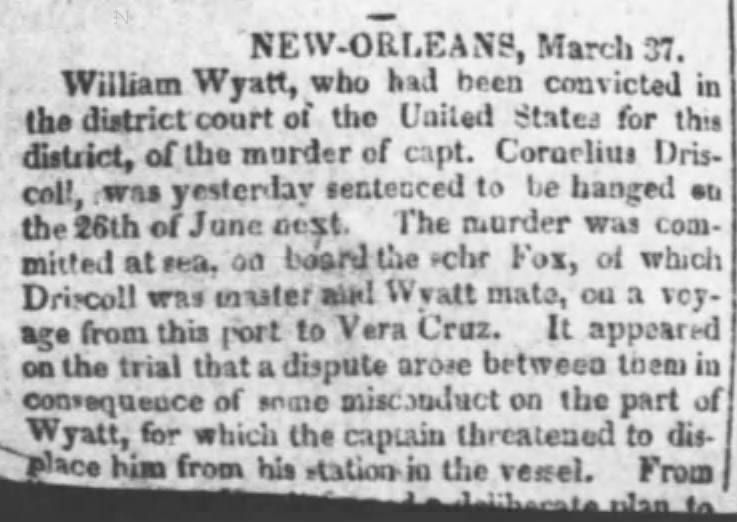
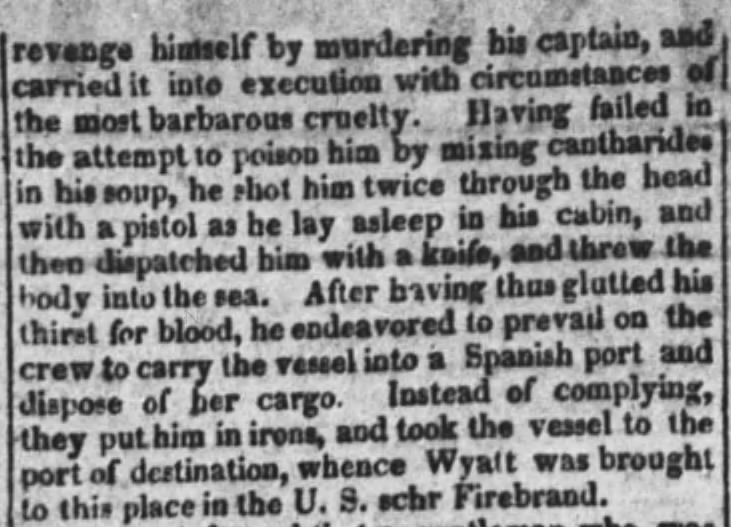
William Wyatt was a sailor aboard the schooner Fox on a voyage from New Orleans to Veracruz, Mexico in 1817. En route, a dispute between Wyatt and Captain Cornelius Driscoll escalated to murder. Wyatt then sought to commandeer the ship into Mexico. The crew of the Fox fought back, shackled Wyatt, and returned to New Orleans.

New York Evening Post, April 28, 1818

Wyatt was convicted of murder in New Orleans in March 1818. After President Monroe declined to intervene, William Wyatt was hanged there on June 25, 1818.

Joseph T. Hare and John Alexander

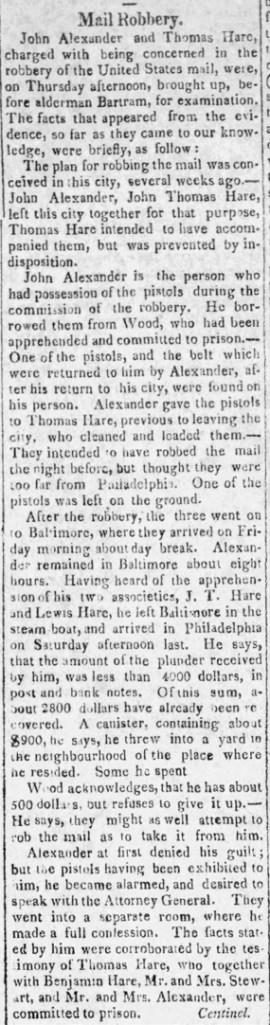
In the early decades of American history, the federal criminal legal system was small and federal capital cases were few. Federal capital cases arose less from federal statutes that enacted distinct federal crimes than from the Constitution, Article II, Section II of which provided federal jurisdiction for maritime (including piracy) cases and cases involving multiple states. The only other type of federal capital case that arose during this era was mail robbery, a crime against a federal agency. The first case of this type occurred in Maryland. In March 1818, notorious highwayman Joseph Hare, joined by John Alexander, robbed the United States mail near Havre de Grace, stealing tens of thousands of dollars. They were arrested in Baltimore soon after when their appearance and the money they were spending drew attention.

Lancaster (Pa.) Intelligencer, March 25, 1818

The men were convicted and sentenced to death in May 1818. Hare’s brother, Lewis, only 19 years old, was also convicted but subsequently pardoned. A fourth man, William Wood, tried in Philadelphia as an accessory before the fact to the crime, was found guilty and sentenced to ten years of hard labor.

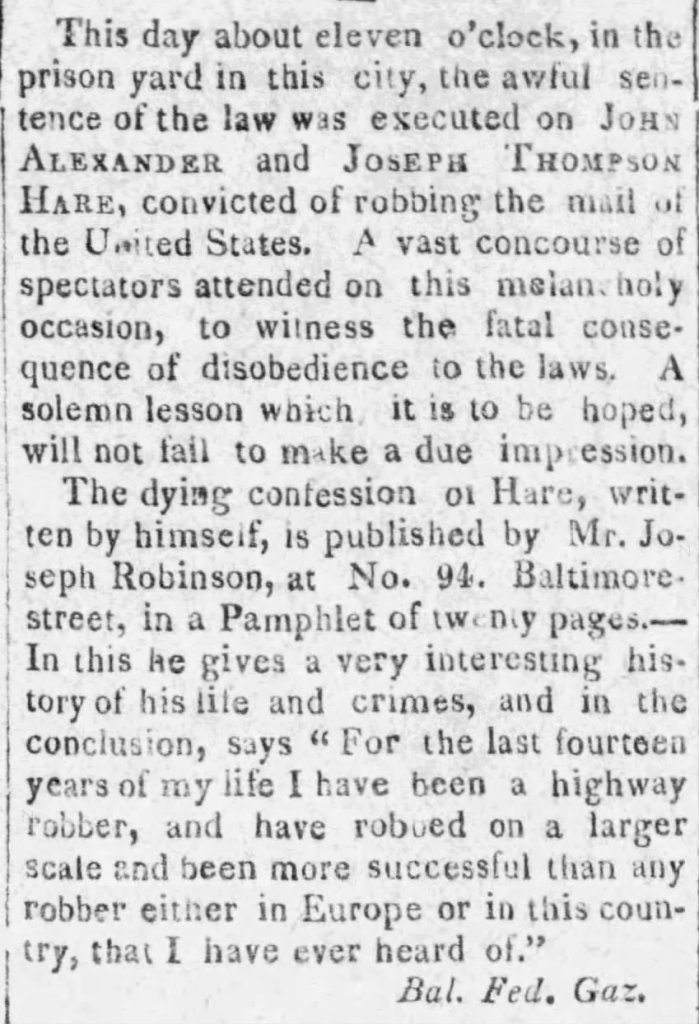
Hare and Alexander were hanged before a large crowd on September 10, 1818.

Lancaster Intelligencer, September 14, 1818

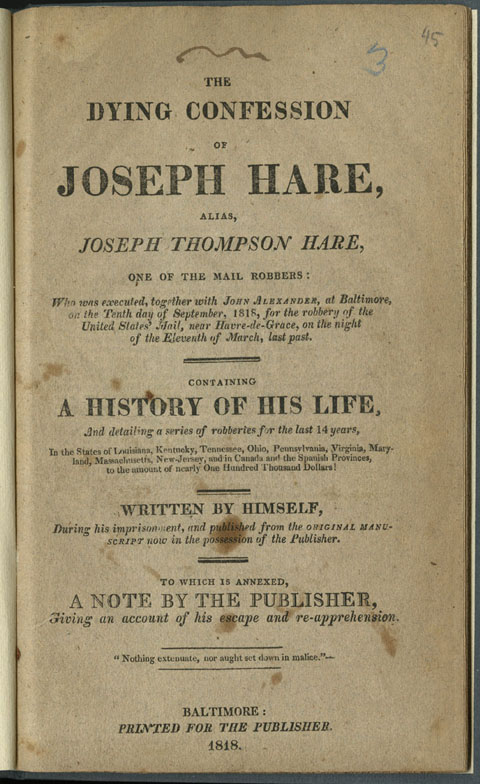
In a posthumously published confession, Hare claimed to have been a prolific thief.