Samuel Tully

Samuel Tully and John Dalton were sailers aboard George Washington, on its maiden voyage from Delaware in October 1811. The ship, captained by Uriah Phillips Levy, picked up a cargo of Spanish wine and coins at Tenerife, Canary Islands, before sailing to the Cape Verde Islands.

While at anchor, Tully and Dalton took control of the ship, killed fellow sailer George Cummings, and sailed off without the knowledge of the captain or other crew.

Crossing the Atlantic, they landed in St. Lucia. Once evidence of their crime was detected, the men were returned to American jurisdiction at Martha’s Vineyard and then transferred to Boston.

Tully and Dalton were tried in the First U.S. Circuit Court in Boston in October 1812. Both were convicted and sentenced to death.
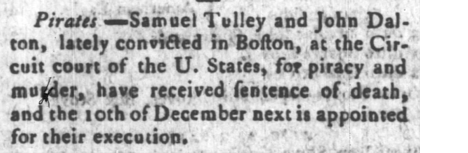
Pennsylvania Gazette, November 18, 1812

After his conviction was upheld on appeal (United States v. Tully, 28 F. Cas. 226, 1812), Samuel Tully was hanged in South Boston on December 10, 1812. In a remarkable display of both terror and mercy, John Dalton’s execution was reprieved on the gallows. He was pardon in July 1813 and released from prison.

Pennsylvania Gazette, December 23, 1812

Joseph Baker, Joseph Berouse, and Peter LeCroix

Baker (Boulanger), Berouse, and LeCroix, fellow French Canadian sailors aboard Eliza, conspired to kill three other sailors and seize the ship’s cargo. The ship was en route from Philadelphia to St. Thomas in the Caribbean. The killings – of Charles Rey, Thomas Croft, and Jacob Sutter – occurred at sea in September 1799.

Like Maunier and his co-conspirators before them, the plan failed when the men proved unable to sail Eliza.

While attempting to sail into Spanish territory, Captain William Wheland was able to retake control of the ship. He sailed into harbor at St. Bartholomew, where the captured men were put aboard the U.S. Navy vessel Eagle and returned to Philadelphia.

Vergennes (Vermont) Gazette, November 28, 1799

Under examination, the three men confessed, claiming that they were agents of the French government acting under that authority. They were placed on trial for murder on the high seas on April 21, 1800. All three were convicted and sentenced to death on April 25.

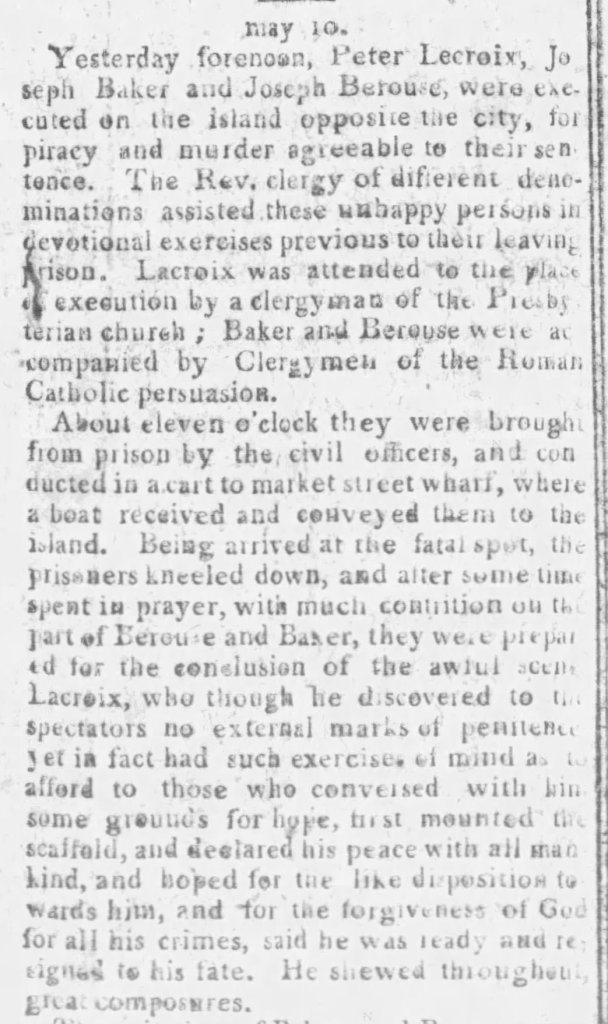
Baker, Berouse, and LeCroix hanged together on a small island in the Delaware River before a large onshore crowd on May 9, 1800.

Vergennes (Vermont) Gazette, July 29, 1800

Philip Maunier, Claude Pain, John Edwards, and Henry McDaniel

Maunier, Pain, Edwards, and McDaniel were among the multinational crew of a ship sailing from Charleston, South Carolina to Bordeaux, France, carrying a shipment of indigo and rice.

Not long after setting sail, the men carried out a plan to kill the ship’s captain and mate with the intention of selling of the cargo. Their plan failed when they were unable to sail the pirated vessel.

Captured by another vessel while still off the coast of the Carolinas, they were brought into port in North Carolina. There they were tried for murder on the high seas before the Circuit Court for the District of North Carolina, convicted, and sentenced to death.

Pennsylvania Gazette, July 3, 1793

The convictions of Maunier, Pain, Edwards, and McDaniel were upheld on appeal and they were executed by hanging before a crowd of thousands in New Bern, North Carolina on July 6, 1793.

Thomas Bird

Thomas Bird was a sailor aboard Mary, a small British slave ship that carried newly-enslaved Africans to larger slave ships for transport to the Americas. For reasons that were never made clear, Bird killed Mary’s captain, John Connor, who had a reputation for violence.

Bird was arrested when the Mary docked in Portland, Maine, which was a district of Massachusetts until statehood in 1820.

Though Bird, Connor, and Mary were all British, Article 3, Section 2 of the recently-enacted United States Constitution provided federal jurisdiction for all maritime cases.

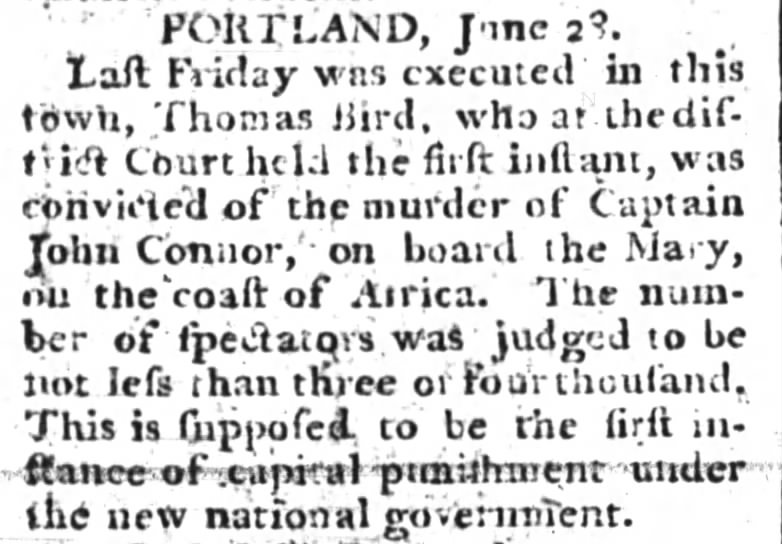
Poughkeepsie Journal, July 17, 1790

Thomas Bird was convicted of murder on high seas and sentenced to death on June 4, 1790. After his pardon request was rejected, he was hanged by the U.S. Marshal Service in Portland on June 25, 1790. It was the first federal execution in United States history.