Documenting and Analyzing the History of Federal Executions
Author: Bill Lofquist
I am a sociologist and death penalty scholar at the State University of New York at Geneseo. I am also a Pittsburgh native. My present research focuses on the history of the death penalty in Allegheny County (Pittsburgh), Pa.
Despite a history of questionable behavior and criminal allegations, Sheppard Busby served briefly as a United States Marshal in 1890 and 1891. On August 9, 1891, just months after leaving the service, Busby shot and killed U.S. Marshal Barney Connelly when Connelly attempted to serve him papers alleging adultery.
Busby, who was 58 years old, was a Civil War veteran of the Union Army. He was living with three much younger women at the time of the killing.
At trial in Fort Smith, Busby was convicted of murder on December 11, 1891, and sentenced to death on January 21, 1892.
Sheppard Busby was hanged in Fort Smith on April 27, 1892.
On April 29, 1889, Irwin Richardson was shot and killed while performing at a dance held by a group of Black residents of the Choctaw Nation. George Tobler, who had quarreled with Richardson earlier in the day, fired the shot.
Tobler was immediately arrested and sent to Fort Smith to be held for trial.
George Tobler was convicted of murder on September 19, 1889, and sentenced to death in October. Originally scheduled to hang on January 19, 1890, Tobler’s execution was respited briefly. Tobler was hanged at Fort Smith on January 30, 1890.
Henry Wilson left Leflore, Choctaw Nation, for Polk County, Arkansas, on March 12, 1889. He was going to get a horse for a local farmer and would be traveling alone.
When Wilson did not arrive at his destination, a search began. That search ultimately led to Jefferson Jones, who admitted to shooting Wilson but claimed he did so in self-defense.
Jones, who was Choctaw, was tried in federal court in Fort Smith. He was convicted of murder on October 12, 1889, and sentenced to death on November 1, 1889.
On May 25, 1883, Harris Austin killed Thomas Elliott in Tishomingo, Chickasaw Nation. The killing followed an argument in which Elliott had accused Austin’s half-brother, Jonas Pearson, of stealing alcohol from him.
Nearly six years passed before he was arrested and jailed in April 1889.
Austin was convicted of murder on August 31, 1889, and was sentenced to death on November 1, 1889.
Harris Austin was hanged at Fort Smith on January 16, 1890.
Grant Williams worked in building the Rock Island rail line near Ardmore, Indian Territory. His pay in August 1904 was less than what he was due. When that situation was not rectified, he shot and killed paymaster James Dolan on October 19. He also shot another worker with whom Dolan was talking and a passerby.
Fleeing to Arkansas, Williams was not arrested for more than a year. Returned to McAlester to stand trial in federal court, Williams, who was Black, was convicted and sentenced to hang.
The case of Henry Scott is a remarkable chapter in the annals of American racial violence.
Scott was a crew member on the Harry A. Berwind en route from Mobile, Alabama to Philadelphia. Off the coast of North Carolina on the morning of October 10, 1905, Scott systematically killed and threw overboard all of the white crew members and ordered the surviving Black crew members to dock in Cape Fear, North Carolina.
As they headed into port, Captain John Taylor of the Blanche H. King became suspicious of the Berwind and came up beside it. He found three Black sailors, and a fourth Black sailor, John Coakley, who had been killed. Taylor placed the three men – Scott, Robert Sawyer, and Arthur Adams – in custody.
Investigation concluded that Scott had killed Coakley and the other two men were accomplices. Under questioning, Sawyer and Adams told the macabre tale of Scott killing the four white crew members – Edwin Rumill, John Hall, John Falbe, and C.F. Smith. Scott told precisely the opposite story, implicating Sawyer and Adams. Scott later changed his story, claiming that the four Black men acted together in a racially-motivated mass killing.
In a context of white racial fears, this latter story was viewed as most credible and became the basis of the public perception and prosecution’s theory of the case.
The trial of Sawyer and Adams began in federal court in Wilmington on November 1, 1905. With Captain Taylor as a key witness, the prosecution claimed the four Black men acted in concert; a view of the case that would have left the cargo of the Berwind to Taylor and his crew. Scott told a similar story, of a racial mutiny. Sawyer and Adams testified that Scott alone was responsible for the killings.
Sawyer and Adams were convicted and sentenced to death. Their convictions were upheld on appeal all the way to the U.S. Supreme Court.
Tried separately, Scott was also convicted and sentenced to death.
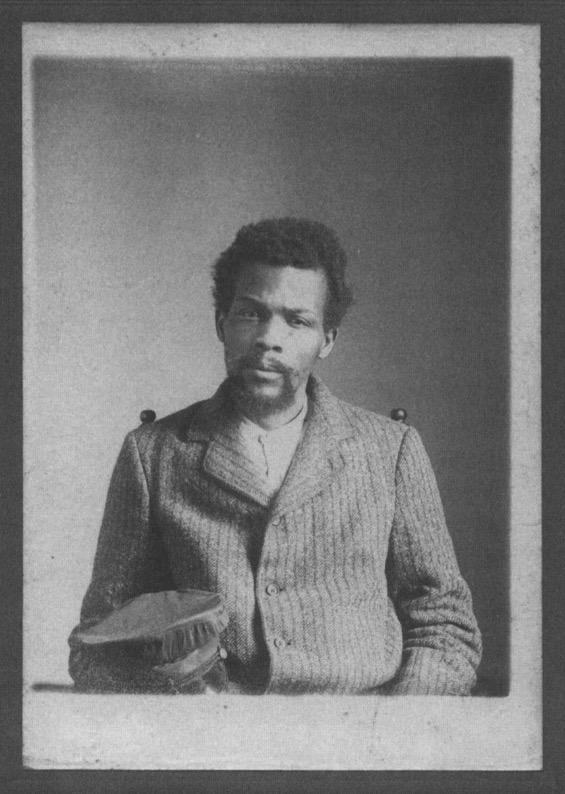
Henry Scott
While awaiting execution, a letter sent to Scott presented information that he had previously killed two white men and had dedicated himself to killing white people. Presented with this information, Scott confessed to the killings and acknowledged that Sawyer and Adams were innocent.
Henry Scott was hanged on July 6, 1906.
Based on the new evidence, the executions of Sawyer and Adams were delayed. After further review, President Roosevelt commuted their death sentences to life imprisonment and they were transferred to the federal penitentiary in Atlanta.
With continuing questions about their guilt, Sawyer and Adams were ultimately pardoned by President Taft on January 2, 1912, and released from custody.
Much of this account is drawn from “Washed Down in Blood: Murder on the Schooner Harry A. Berwind“ Author(s): Vann Newkirk Source: The North Carolina Historical Review, Vol. 91, No. 1 (JANUARY 2014), pp. 1-29
Rufus Binyon, his wife, and an eight-year old orphaned girl named Mary Hawthorne, all of whom were Black, lived near Ran, Indian Territory.
On May 18, 1900, while his wife was away from home, Binyon raped and killed young Mary, put her body in the fire to destroy the evidence of his crimes, and left. When his wife returned, she found Mary’s body in the fire and, believing she had fallen into the fire, yelled for help.
When neighbors responded and pulled Mary’s body from the fire, they realized that she had been beaten. Rufus confessed.
Binyon was convicted of murder on January 15, 1902, and was sentenced to death. After appeals that went all the way to the U.S. Supreme Court, Rufus Binyon was hanged in Ardmore on September 22, 1905.
Robert Cotton and his wife, Cynthia, lived in Vian in the Indian Territory in the final days before Oklahoma statehood. On August 6, 1905, Robert, who was Black and had escaped from prison in Tennessee, stabbed and killed his wife.
Once arrested, he confessed. At trial in federal court in Sallisaw, Cotton was convicted of first-degree murder on May 26, 1906, and sentenced to death on June 1.
Robbert Cotton was hanged at Vinita on September 4, 1906.
On December 3, 1902, Charles Barrett robbed and killed John Hennessey, in Calvin, Indian Territory. Hennessey was an older, reclusive man who was known to have a lot of money.
Investigation of the killing led to circumstantial evidence implicating Barrett. Continuing investigation then led to a note from Barrett’s wife implicating Barrett and, subsequently, a confession from Barrett.
Oklahoma State Capitol, December 20, 1902
At trial in federal court in McAlester, Barrett was convicted of murder on June 3, 1903, and sentenced to death. Charles Barrett was hanged on July 17, 1903.
Dora Wright and Joshua Harvey lived in Wilburton, Choctaw Nation, Indian Territory, with Annie Williams, a seven-year old child. Reports varied as to whether Wright and Harvey were married and as to whether Williams was their child, a step-child, or a foster child.
McAlester Daily News, February 5, 1903
Whatever the case, in the weeks before her death in February 1903, authorities became aware that Williams was being abused. Whatever efforts were made to stop that abuse were unsuccessful. Then, on February 3, Wright notified authorities that Williams was dead.
When authorities went to the home, they found evidence of horrific abuse. Though Wright acknowledged beating Williams, she claimed that her death resulted from a rape committed by a white man.
At trial in federal court, Dora Wright was convicted of murder on May 30, 1903, and sentenced to death on June 4. Charges against Harvey were not pursued.
Along with Charles Barrett, Wright’s was the first federal death sentence imposed in the newly constituted court.
In a fast-moving case, Dora Wright was hanged on July 17, 1903.
Dora Wright was the first woman ever executed by the United States government.


 The Federal Death Penalty Project