Documenting and Analyzing the History of Federal Executions
Author: Bill Lofquist
I am a sociologist and death penalty scholar at the State University of New York at Geneseo. I am also a Pittsburgh native. My present research focuses on the history of the death penalty in Allegheny County (Pittsburgh), Pa.
On December 9, 1887, James Mills, Tom Robbins, John Windon, and Windon’s young stepson went hunting. For reasons that are lost to history, Mills shot and killed Windon; Robbins also shot Windon. Mills and Robbins then threatened Windon’s stepson to remain silent about the killing.
Windon’s body was found the next day.
Arrested and taken to Fort Smith for trial, Robbins died before he could be tried. Mills was found guilty of murder on November 10, 1888, and sentenced to death on February 2, 1889.
James Mills was hanged at Fort Smith on April 19, 1889.
By the time he was put on trial for murder, Malachi Allen had already tried for violent crime. In 1884, Allen, who was Black, was charged, tried, and acquitted for the assault with intent to kill of John Kemp.
On July 1, 1888, Allen shot and killed Silas Love and Shadrack Peters, two Black men, in a dispute about a saddle near Winewood, Indian Territory.
Allen was arrested the next day. At trial in Fort Smith in January 1889, Allen claimed he acted in self-defense. He was found guilty on January 5 and sentenced to death on February 2.
Malachi Allen was hanged at Fort Smith on April 19, 1889.
Thomas Pringle lived with Hattie Seals in the Choctaw Nation. The two were in the woods together on March 28, 1888, when Pringle was shot. Before he died, he told Seals that he suspected a man named Murphy had shot him.
Pringle’s brother, Charles, tracked the killer by his distinct bootprint, which led to the home of Richard Smith. Smith, who was Black, was arrested soon after. Many witnesses came forward in support of Smith’s arrest. Apparently Smith and Pringle had quarreled not long before the killing.
At trial in Fort Smith, Richard Smith was convicted of murder in August 1888 and sentenced to death on November 3. He was hanged on January 25, 1889.
On June 27, 1887, William D. Morgan, a white coal miner who lived in the Choctaw Nation just north of the Texas border, left home to travel to south Texas in search of a climate better suited to his tuberculosis.
His body was found the next day near Blue Tank, Indian Territory. He had been strangled, robbed, and beaten.
Gus Bogle, a Black man from Texas, was arrested on June 30. Surviving records do not indicate how he became a suspect. He denied all knowledge of the killing.
At trial in Fort Smith, witnesses testified that Bogle was among a group of Black men seen on a train with Morgan. Bogle was convicted of murder on June 10, 1888, and sentenced to death on June 26. Gus Bogle was hanged on July 6, 1888.
Owen Hill was born in Alabama, probably into slavery, before moving to Arkansas as a young man. A letter written by Hill after killing his wife, Vinna Anderson, revealed that when he and Anderson planned to marry, he learned that she was still married and had been estranged from her husband in part by tensions created by her mother.
Hill and Anderson married and lived in Fort Smith while her mother lived in Indian Territory. While his wife was visiting her mother, he accepted a request to move to the area. Tensions with his mother-in-law followed, which led to tensions and altercations with his wife.
On June 25, 1887, Hill returned from work to find that his wife and child were gone. When he went to his mother-in-law’s house, he was told at gunpoint that he was not welcome. He returned with a gun the next day, beat his mother-in-law with the gun and stabbed and killed his wife. He then fled to Kansas City.
Curious as to whether his wife had died, he wrote a lengthy letter to his landlord asking about her. The letter was enough to implicate him. He was arrested and brought to Fort Smith.
At trial, the letter and the testimony of his mother-in-law were enough to convict Hill. He was sentenced to death on February 10, 1888.
George Hill was hanged at Fort Smith on April 27, 1888.
George Moss was among of group of men who decided to kill and steal a beef cattle from the range near the Red River, along the southern border of the Choctaw Nation on November 26, 1886. Their plan went awry when George Taff, the owner of the cattle, just happened to be in the area at the time. When Taff, a prominent rancher, responded to the sound of the gunshot, he was shot and killed.
The men fled, with Moss losing his horse in the process. When Taff did not return home, a search began. When his body was found, Moss’s horse was found nearby.
Moss was arrested and taken to Fort Smith to await trial. As registered members of the Choctaw Nation, the other assailants were not subject to U.S. jurisdiction. They were reported to have been killed in retaliation by local residents concerned that they would be unpunished.
George Moss was convicted of murder on September 17, 1887, and sentenced to death. He was hanged at Fort Smith on April 27, 1888.
August 6, 1884, was election day in the Choctaw Nation. Charles Wilson, the incumbent, was running to retain his seat as county representative against Robert Benton. As Wilson returned home early the following morning, he was confronted by Benton, Jackson Crow, and nine other men. Wilson and Benton argued and Wilson was killed.
That Wilson was murdered was clear; parceling responsibility for that killing was the harder question. Investigation revealed that Crow and Wilson had been at odds for months after Wilson played a role in Crow’s arrest for murder. Though Crow was ultimately cleared, he swore retribution against Wilson. Wilson and Benton had also feuded.
Crow was the only one of the men who was not a member of the Choctaw Nation, meaning he was the only person subject to the jurisdiction of United States courts. Because of their prominence, the men tried in Choctaw court were handled with leniency. Crow, on the other hand, was the son of a Native father and Black mother who had never taken advantage of the Choctaw citizenship available to him.
What role Crow’s vulnerability to US jurisdiction played in his prosecution is unclear. Whatever the case, he was arrested on January 2, 1887. At trial in Fort Smith, Crow argued that he played a minor role in the skirmish that resulted in Wilson’s death and that Benton was the killer. That defense failed and he was convicted of murder and sentenced to death on February 10, 1888.
Along with two other men, Jackson Crow was hanged on April 27, 1888.
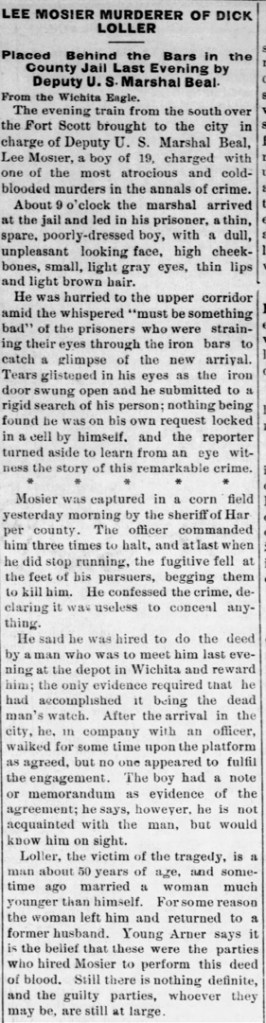
Lee Mosier and Robert Arner were traveling with Hugh Benton Lawler on a trip from Anthony, in Indian Territory, to Kansas, on October 27, 1886. Without warning or provocation, Mosier, who was 20-years old, shot and killed Lawler. He then drove off with Lawler’s wagon while Arner escaped. The killing occurred within Indian Territory.
A search party found and arrested Mosier on October 31. He was held for trial is federal court in Wichita. When arrested and at trial, Mosier claimed he was first introduced to the plan to kill Lawler by Arner. Once he agreed, he and Arner were hired by Lawler’s wife, who was reported to be much younger and estranged, to kill her husband and were paid $2,000.
In the state’s version of events, Mosier’s motive was robbery and Arner, who was not involved, was spared in return for his promise of silence. Allowed to leave after the shooting, Arner quickly reported what had happened.
Prior to Mosier’s trial, Mrs. Lawler was arrested and tried for her alleged role. She was acquitted.
At trial in federal court in September 1887, the State’s version of events prevailed. No evidence was presented to corroborate Mosier’s story. Mrs. Lawler and Arner testified against Mosier.
Harper (Kansas) Sentinel, November 6, 1886
Mosier was found guilty on September 15, 1887, and sentenced to death. Lee Mosier was hanged on November 15, 1887.
Seaborn Kalijah (alias Green) was a young Creek man who killed Mark Kuykendall, Henry Smith, and William Kelley on January 17, 1887. The three men worked as posse and guards for Deputy U.S. Marshal Phillips.
At issue were the circumstances of the killing. Kalijah claimed that the three men, who had apprehended him for bringing alcohol into the Indian Territory, had abused him and that he acted in self-defense. Also arrested were two of Kalijah’s relative, Doctor Walker and Josh A.E. Harjo. Investigation suggested that Walker was the principal in the killings.
At trial in Fort Smith, Kalijah testified that he acted alone. That protected his relatives, both of whom were acquitted. Kalijah was convicted of murder on July 13, 1887. After being sentenced to death, Silas Kalijah was hanged on October 7, 1887.
After working for a time building the Atlantic and Pacific Railroad between Tulsa and Red Fork, in Indian Territory, brothers John and Tom Mahoney returned home to Kansas in early 1886. Patrick McCarty and Joe Stutzer were vagabonds who rode with them.
Recognizing that the brothers were carrying their pay and valuable goods, the two passengers conspired to rob and kill the Mahoneys. Near the Kansas border, they carried out the plan and then burned their bodies and everything else they did not steal. They then sold what they had stolen, split up, and returned to their homes.
The bodies of the Mahoney brothers were found in March and ultimately identified. The investigation ultimately led to McCarty, who was living in Missouri. When he was arrested, he was found to be in possession of stolen property. Stutzer was never apprehnded.
Taken to Fort smith to stand trial, Patrick McCarty was convicted of murder in September 1886 and sentenced to death on October 30. After a respite brought hope of a reprieve, McCarty was hanged at Fort Smith on April 8, 1887.
 The Federal Death Penalty Project