William Finch

Born into slavery in Georgia, William Finch was stationed at Fort Sill in 1882 as a U.S. Army tailor. When threatened with punishment for a minor offense, Finch fled to Texas. Captured there, he was returned to Fort Sill. En route, Finch killed two of his captors, Sergeant Johnson and Private Grimky, and fled back into Texas.

The third soldier in the arresting party survived and alerted authorities. Finch was arrested again in Texas.

Taken to Fort Smith, Finch was tried for murder in February 1883. He was convicted of murder and sentenced to death. William Finch was hanged on June 29, 1883.

Robert Massey

After driving a herd of cattle into the Dakota Territory, Edmond P. Clark and Robert Massey returned home to Texas. En route, they stopped in Indian Territory in December 1881, where Massey killed Clark. He then stole his horse and gun, hid his body, and rode off.

When Clark did not return home, his family made inquiries. When a body was discovered, the connection was made with those inquiries. After further investigation confirmed that the body was Clark, the search for Massey began.

Robert Massey was arrested near Fort Sill in April 1882. Taken to Fort Smith, he was tried on the circumstantial evidence that had been collected. In his defense, Massey argued that he had acted in self-defense. He was found guilty on December 11, 1882, and sentenced to death on February 1, 1883.

Robert Massey was hanged on April 13, 1883.

Brave Bear

Joseph Johnson was a former soldier who had served at Fort Bennett in the Dakota Territory. When his enlistment ended, he decided to join his brother in business nearby.

Brave Bear knew of Johnson’s plans and also knew he was carrying a large sum of money and other goods. On May 15, 1879, he intersected with Johnson, told him he was traveling in the same direction, and killed him when he had the chance. He then robbed him and fled toward Canada to join his father in law, Sitting Bull, leader of the Lakota tribe forced north after the massive U.S. government response to the defeat of General Custer’s troops in 1876.

En rote, Brave Bear met Edward Allison, a U.S. military scout who recognized Johnson’s rifle and horse. When Johnson’s body was later discovered, Allison reported what he had seen.

When Sitting Bull was forced to surrender in 1881, Brave Bear was arrested after crossing back into the United States. He was taken to Yankton to stand trial.

In US District Court for the District of Dakota Territory in Yankton, Brave Bear was found guilty of murder in December 1881, and sentenced to death on January 9, 1882. Judge Edgerton set his execution for July 20, 1882.

After a 60-day reprieve from President Arthur, Brave Bear was hanged on November 15, 1882.
Edward Fulsom

In August 1881, William Massingill was staying at the home of John Stewart, in the Choctaw Nation. While there, James Hobbs and Edward Fulsom, the only Choctaw of the group, came to the home and shot and killed the two men.

Fulsom was arrested, Hobbs escaped and was never captured.

At trial in Fort Smith, it was learned that Fulsom and Hobbs were in business together stealing cattle and selling whiskey illegally. Stewart’s home, which was also a tavern and a gambling den, was in their territory. When they stopped there, they argued with Stewart before deciding to shoot him. Massingill was killed when he happened into the fight. There is also a suggestion that Fulsom and Hobbs were hired to kill Stewart.

The defense argued that Hobbs was an unknowing accomplice. They also argued that the killings occurred in Arkansas, which would have invalidated federal jurisdiction.

Edward Fulsom was convicted of murder and sentenced to death. He was hanged at Fort Smith, Arkansas, on June 30, 1882. President Garfield’s assassin Charles Guiteau was hanged in Washington, D.C. on the same day.

George W. Padgett

A man named Stevens was driving 2,200 head of cattle through Indian Territory en route to Kansas from Texas. Near the Comanche Agency, he hired George Padgett to help him. When Padgett identified some of the cattle as bearing the brand of a man named William Waggoner for whom he had previously worked, Padgett tried to take possession of those cattle.

Stevens resisted and the men argued. When the men arrived at their destination on July 26, 1880, Padgett again asked about the the cattle in question. The men argued again. When Stevens tried to leave, Padgett shot and killed him. There were witnesses to the shooting.

Padgett confessed at the time of his arrest.

Expecting that the circumstances of the case would lead to a manslaughter verdict, Padgett was convicted of murder on February 17, 1881.

George Padgett was hanged at Fort Smith on September 9, 1881.

Patrick M. McGowan

Patrick McGowan and Sam Latta had been business partners in a 300 acre parcel of land in the Chickasaw Nation. A disagreement led Latta to buy out McGowan, though hard feelings remained.

Those hard feelings were stoked by a friend of McGowan’s, William Hunter, who had also argued with Latta. So upset was Hunter that he encouraged McGowan to retaliate against Latta. Once McGowan was on his way to Latta’s, Hunter left him. When McGowan arrived at Latta’s home, he shot him on sight. Latta’s family witnessed the killing.

Once arrested, McGowan claimed Latta had threatened him numerous times and that McGowan had instigated the fight that led to his death.

At trial in Fort Smith, McGowan was convicted of murder on May 17, 1881, and sentenced to death. Hunter was never arrested; at the time, no law criminalized being an accessory before the fact.

With four other men, Patrick McGowan was hanged on September 9, 1881. From the gallows, he professed his innocence.

William T. Brown

William Brown, Ralph Tate, and several other men formed a crew of workers employed cutting hay at Fort Sill, Indian Territory in August 1880. When Brown and one of the men got into an argument and then a fight, Brown retrieved his gun and, intending to shoot the man, shot and killed Tate.

Brown fled. Tate’s father pursued him doggedly, with one report suggesting the pursuit lasted for weeks and covered hundreds of miles. Once Brown was captured, he was taken to Fort Smith and arrested. He confessed.

Brown was convicted of murder on March 3, 1881, and sentenced to death. With four other men, he was hanged on September 9, 1881.

Amos and Abler Manley

Amos and Abler Manley were Creek Indian brothers who were implicated in the death of Eli McVay, a white man, near Eufaula, Indian Territory, in December 1880. The brothers knew McVay and were welcomed in when they stopped at his house, saying that they were looking for a place to rest while traveling.

While McVay slept, the Manley brothers shot and killed McVay. They also assaulted McVay’s hired hand, Bill Barnett. His wife ran and was able to avoid shots fired at her.

After a hung jury in their first trial, Amos and Abler Manley were tried a second time. Despite several alibi witnesses, the inculpatory testimony of McVay’s wife prevailed and the brothers were convicted and sentenced to death on June 16, 1881.

Amos and Abler Manley were hanged at Fort Smith on September 9, 1881. From the gallows, hey are reported to have confessed to killing McVay, though in self-defense.

Ka-Ta-Ta

In a case remarkably similar to the execution of Kot-Ko-Wat three years earlier, Ka-Ta-Ta was as Alaska Native implicated in the deaths of two white men, in this case two miners.

The story that emerged was that a small party of prospectors sailed north out of Sitka to French Harbor. Once they reached their location, they hired some Alaskan Natives – including Ka-Ta-Ta – to assist them in their explorations of the interior. On that trip, Ka-Ta-Ta is said to have killed Thomas Maloney and Kerin Canby.

Arrested and transported to Portland for trial, Ka-Ta-Ta was tried before Judge Deady in the US District Court for the District of Oregon in March 1882, convicted, and sentenced to hang.

Ka-Ta-Ta was hanged in Portland on March 28, 1882.

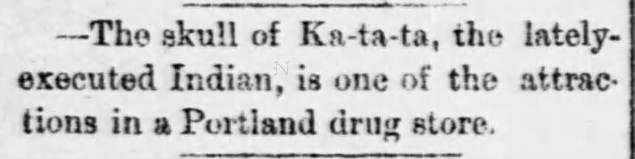
As with -Kot-Ko-Wat, this case raises all the same legal questions of how a defendant was transferred from one jurisdiction to another to stand trial; the answers to which are likely related to the absence of an Alaskan court system that could reliably produce the conviction of a Native in cases involving white victims and the deeper racism underlying the treatment of Native populations (see the newspaper item below).

Morning Astorian (Astoria, Oregon), April 20, 1882

Kot-Ko-Wat

Kot-Ko-Wat was a Chilkat Indian, a tribe located along the Alaskan Coast. He killed Thomas J. Brown in Sitka, Alaska Territory in early 1879.

For reasons that are not entirely clear, though are probably related to concern that the killing of a white man by an Alaskan Native would not produce a conviction in Alaskan courts, Kot-Ko-Wat was transferred to Oregon for prosecution. Given the issues of sovereignty such a maneuver raises, it is also not clear how this was justified under law. The jarring racism directed at Native Americans may offer insights.

Albany (Oregon) Democrat, April 25, 1879

Nonetheless, Kot-Ko-Wat was convicted of murder in the United States District Court for the District of Oregon and was sentenced to death by Judge Matthew Deady on April 25, 1879.

Kat-Ko-Wat was hanged in Portland, Oregon, on May 8, 1879.