William Elliott Wiley

William “Colorado Bill” Wiley was a Union Army veteran who moved west after the Civil War, ultimately settling in Muskogee, Indian Territory.

In February 1879, David Brown and Ross Cunningham went to the brothel where Wiley lived. When the two men overstayed their welcome, Wiley urged them to leave. When Brown reached for a gun, Wiley shot and killed him and wounded Cunningham.

At trial, Wiley was convicted and sentenced to death. He was hanged at Fort Smith on September 5, 1879.

Henri Stewart

Henri Stewart was born in the Choctaw Nation to a Choctaw father and a white mother. Though accounts of his education and employment vary, he was well educated and trained as a physician.

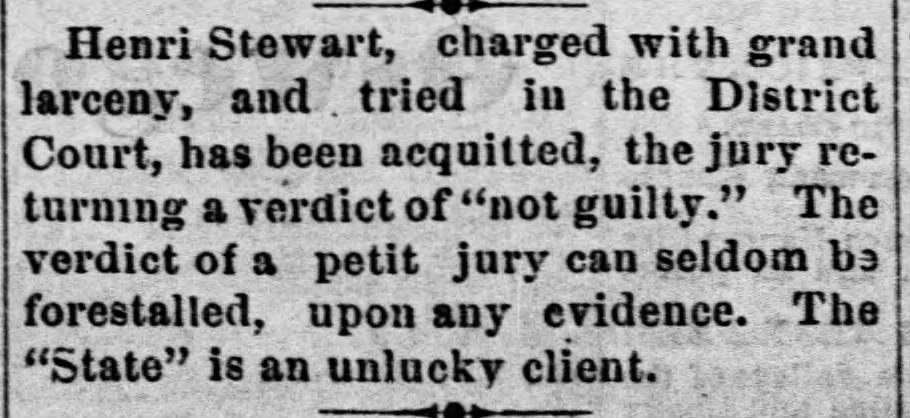
Why he did not continue to work in that field is not clear. In 1874, he was tried and acquitted on grand larceny charges.

Oswego Independent, March 14, 1874

In 1878, he and his cousin, Wiley Stewart, were arrested for selling alcohol in Indian Territory. When an associate, Dr. Jones, refused to bail them out, they threatened him and, ultimately, shot and killed him in Caddo, Indian Territory.

The Stewarts then fled. Henri Stewart was arrested in Missouri on August 30, 1878. Transported to Fort Smith, he was convicted and sentenced to death in June 1879.

Henri Stewart was hanged at Fort Smith on September 5, 1879.

John Postoak

John Postoak went to the home of John Ingley, near Eufaula in Indian Territory, to ask him to carry two letters with him to Okmulgee. Ingley responded angrily that he was not going to Okmulgee and that Postoak, who was Creek, was not welcome in his home.

Postoak left, went to a nearby home and borrowed a gun, ostensibly to shoot an animal, and shot and killed Ingley. He then shot and killed Ingley’s wife and set their house on fire.

By the time the Ingley’s were discovered twelve days later, their bodies had been eaten by animals. Their young child was still alive. Postoak confessed when arrested.

At trial in Fort Smith, Postoak was convicted of murder on August 16, 1878, and sentenced to death on October 14. John Postoak was hanged on December 20, 1878.

James Diggs

Hiram Mann and James Diggs had been hired by J.C. Gould to help him move a herd of cattle through the Indian Territory from Texas and into Kansas in the summer of 1873. Near the northern border of the Indian Territory, Diggs robbed and attacked Mann and Gould. He then told local residents and, later, authorities, that the three men had been attacked and that only he was able to escape.

That story did not stand up to investigation and Diggs, who was Black, was arrested. Taken first to Kansas, he was then moved to Fort Smith to await trial.

However, Kansas authorities failed to send any documents related to the case, leading Diggs to sit in jail for more than a year before being released. Diggs returned to Indian Territory believing the case against him had ended.

He was mistaken. Not only did the case remain open but Hiram Mann had survived the attack, leaving Gould as the sole victim. With Mann as an eyewitness to the murder, the case against Diggs was now quite strong.

Diggs was arrested again on June 24, 1878. Taken back to Fort Smith, he was convicted of murder on November 8, 1878, and sentenced to death the next day.

On December 20, 1878, James Diggs was hanged at Fort Smith, Arkansas.

After more than two years in which no one had been executed in Fort Smith, a wait that was due mostly to the failure of Congress to appropriate money to operate the court through much of 1877, executions had resumed.
Frank Robert

Howard (or Harry) Morris and Frank Robert were white men traveling through the Crow Indian Reservation in Montana in September 1877. After stopping to rest, Robert robbed and killed Morris.

After Morris’s body was found, an investigation led to Robert’s arrest. He was found with Morris’s property. Though Robert confessed to the killing, he said he acted in self-defense. Further investigation found that Robert’s explanation of the events was not consistent with the evidence.

Because the killing occurred on an Indian reservation, Robert was tried in federal court in Virginia City, Montana. He was convicted of murder and sentenced to death on September 16, 1878.

Independent-Record (Helena, Montana), September 17, 1878

After his conviction was affirmed by the U.S. Supreme Court and his clemency request was denied by President Hayes, Frank Robert was hanged on October 31, 1878. In his final statement, he claimed he acted in self-defense.

The Independent Record (Helena, Montana), November 1, 1878

Samuel Peters

After trying and failing to obtain a gun, Samuel Peters, a Choctaw, went to the home of James Hanson, who had previously accused him of stealing, and killed his wife, Charity, a white woman. The killing occurred near Stringtown, Choctaw Nation, in October 1875.

James Hanson was not home at the time.

A posse was formed to track down Peters, who was arrested soon after. He had blood on his clothes.

At trial in Fort Smith, Peters was convicted of murder and sentenced to death. He was hanged on September 8, 1876.

John Valley

Eli Hacket, a white man living in Indian Territory, had a daughter with a Peoria woman. That daughter was living with the brother of John Valley, a Peoria man. A dispute between the two men arose over money to be paid to Hacket’s daughter.

A few days later, John Valley shot and killed Hacket in front of witnesses.

Years passed before John Valley was indicted on May 9, 1876. He was convicted at trial in Fort Smith on May 20, 1876, and sentenced to death on June 21.

John Valley was hanged at Fort Smith on September 8, 1876.

William Leach

William Leach was a Confederate veteran who had moved west after the war, taking up residence in the Cherokee Nation.

His experiences during and after the war involved considerable amounts of violence. At one point he was acquitted of two murders. Once in the Cherokee Nation, he was convicted and jailed for selling alcohol and not paying taxes.

On March 8, 1875, Leach robbed and killed a man named Watkins, with whom he had been traveling. He tried to destroy any evidence by burning Watkins’ body.

On April 9, 1875, Watkins’ body was found. Investigation led back to Leach, who was known to have been with Watkins when he was last seen.

At trial in Fort Smith, William Leach was convicted on December 14, 1875, and sentenced to death on February 5, 1876. Along with five other men, he was hanged on April 21, 1876.

Osey Sanders

O August 6, 1875, Osey Sanders and William Matier, both Cherokee, went to the home of Thomas H. Carlisle, a white man married to a Cherokee woman.

When they arrived, they shot and killed Carlisle and robbed him of a large amount of money. His family fled.

Sanders was arrested two days later by Cherokee authorities and turned over to U.S. authorities. Mrs. Carlisle identified him as one of the killers. Matier was shot while being apprehended; he is reported to have confessed before dying.

At trial in the Western District of Arkansas, Sanders was convicted of murder. He was sentenced to death on February 5, 1876. After sentencing, Cherokee authorities intervened to assert jurisdiction, arguing that Carlisle was an adopted citizen of the Cherokee Nation (Native jurisdiction over crimes in Indian Territory pertained when the victims were Native citizens).

Originally scheduled to hang on April 21, 1876, Sanders’ execution date was reprieved several times under orders from President Grant. Once the jurisdictional dispute was resolved, Osey Sanders was hanged on September 9, 1876.

Gibson Ishtanubbee and Isham Seeley

Gibson Ishtanubbee and Isham Seeley robbed and killed Funny, a Chickasaw doctor, and his cook, a Black woman named Mason, in 1872. Though they confided in neighbors and friends what they had done, no one betrayed their confidence for several years. Then, after a falling out with Ishtanubbee, Kitsie Cobb told authorities about the killings.

Another man cam forward and offered similar details. On that basis, Ishtanubbee and Seeley were tried in federal court, convicted, and sentenced to death on February 5, 1876. They were hanged at Fort Smith on April 21, 1876.

The Vindicator (Atoka, Oklahoma), April 26, 1876