Orpheus McGee

Along the Red River in the Choctaw Nation, three Choctaw brothers – David, Charles, and Orpheus McGee – lived near to white brothers, Robert and W.V. Alexander. Relations between the families were strained. The Alexanders viewed the McGees as unruly and lawless. The McGees viewed the Alexanders as interlopers.

Sometime in April 1875, the McGees encountered Robert Alexander alone as he hunted. The brothers robbed and killed him. After telling friends what they had done, Orpheus McGee was arrested. Alexander’s gun and other property were found in his possession. McGee survived four gunshot wounds resulting from an escape attempt.

Charles McGee was killed while being arrested. David McGee was arrested, tried, and acquitted.

After being found guilty in US District Court for the District of Western Arkansas, on February 5, 1876, Orpheus McGee was sentenced to death. He was hanged at Fort Smith on April 21, 1876.

Aaron Wilson

Aaron Wilson was an Army veteran from Virginia who served in the Indian Territory and remained there after being discharged.

He was arrested for having killed James and John Harris, a father and son who were traveling through Indian Territory toward Texas with a loaded wagon. Wilson is reported to have followed them and then killed them as they slept.

Wilson, who was Black, denied any involvement in the killings, for which there were no witnesses. He was implicated by the testimony of some Wichita men in whom he had confided the killings, apparently expecting them to support the killings of white men.

At trial in the Western District of Arkansas, he was sentenced to death on February 5, 1876. Aaron Wilson was hanged at Fort Smith on April 21, 1876.
James Malone

At the remote desert outpost of Fort Mojave, Arizona, a group of soldiers gathered to drink on January 10, 1876. When one of those soldiers – Richard L. Lawler – passed out from drinking too much, four others – James Malone, Leopold Eith, James Henry, and James Wilcox – took the opportunity to kill the unpopular Lawler by stoning him to death. Lawler had previously testified against some soldiers during a court martial.

The soldiers then threw Lawler’s body into the Colorado River, expecting it to be swept away.

When Lawler’s body was found, an investigation was ordered. The four men were soon arrested, with evidence suggesting Malone’s role as the group’s leader.

The killing of a soldier is a federal offense. At trial in June 1876, Malone and Eith were found guilty and sentenced to death. The other two men were released in exchange for their testimony. After their convictions were affirmed by the U.S. Supreme Court, commutation requests were filed.

Eith’s request was granted and he was resentenced to life imprisonment.

James Malone was hanged on March 15, 1878. He is reported to have confessed from the gallows.

Weekly Republican (Phoenix), March 16, 1878

William John Whittington

William John Whittington was a white man who lived with his family in the Chickasaw Nation, just across the Red River from Texas. On Sunday, February 7, 1875, he and his neighbor, J.J. Turner, traveled in to Texas to visit a bar. After a day of drinking, the men returned home.

On the way, Whittington stabbed and killed Turner, who was carrying a lot of money.

Turner’s son had decided to ride out to meet the men as they returned from Texas. As he did, he saw Whittington alone with two horses. When Whittington saw him, he fled back in to Texas. He was arrested soon after.

Taken to Fort Smith to stand trial, Whittington was convicted of first-degree murder on June 16, 1875.

On June 26, 1875, Whittington became the first person that Judge Isaac Parker sentenced to hang. Along with five other men, he was hanged at Fort Smith, Arkansas, on September 3, 1875.

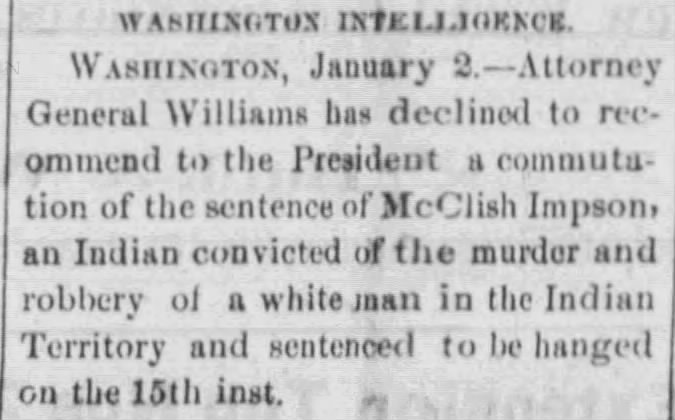
McClish Impson

As a juvenile, McClish Impson was introduced into the adult world of crime by his father. At age 17, in early 1873, Impson, a member of the Choctaw Nation, killed a white man (whose identity was never determined) in Boggy Depot, a formerly prominent town in present-day south central Oklahoma. Robbery was his motive.

After boasting of the crime to associates, those associated notified authorities and Impson was arrested.

Impson first appeared in court in Fort Smith on November 17, 1873. His trial, which would not occur for another year, resulted in a conveiction and death sentence.

Helena (Montana) Independent-Record, January 5, 1875

On January 15, 1875, 19-year old McClish Impson was hanged at Fort Smith, Arkansas. He is reported to have confessed from the gallows.

His was the last execution in the Western Arkansas District Court, long tainted by allegations of corruption, not presided over by Judge Parker.

John Billy

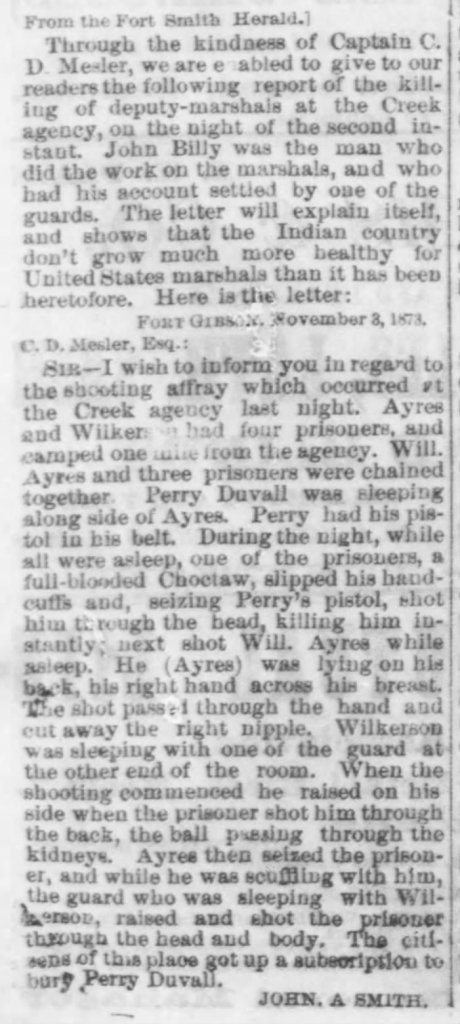
On November 2, 1873, while being transported to Fort Smith to stand trial for assault, John Billy, a member and resident of the Choctaw Nation, was able to escape custody, steal the gun of one of the U.S. Marshals holding him, and kill two of those officers, Willard Ayers and Perry Duval. A third officer – Ed Grayson – shot and wounded Billy.

Memphis Daily Appeal, November 14, 1873

The marshals were reported to have expected trouble from Billy, who had expressed his fear of the way Choctaws were treated at Fort Smith.

John Billy was found guilty of first degree murder in the U.S. District Court for the Western District of Arkansas on December 19, 1873. He was sentenced to death a few weeks later.

On April 3, 1874, John Billy was hanged at Fort Smith, Arkansas. A crowd of thousands had gathered to watch the three hangings that took place that day. Billy is reported to have confessed from the gallows.

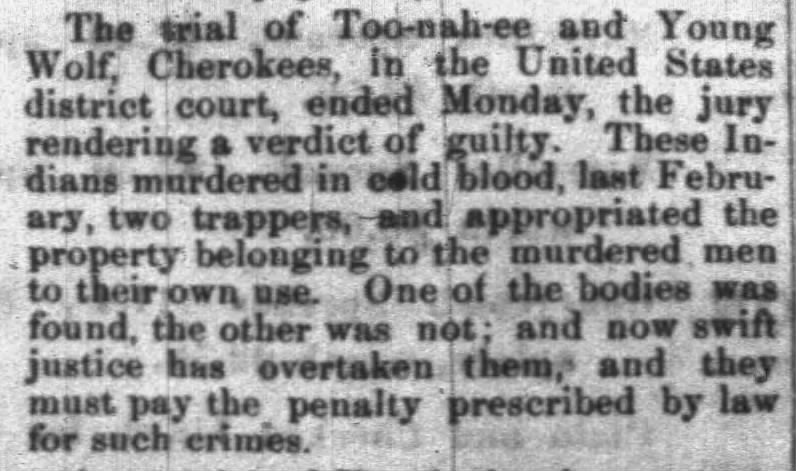
Young Wolf and Tu-Na-Yee

Young Wolf and Tu-Na-Yee had served together in the Cherokee forces on the Union side of the Civil War before returning to the Cherokee Nation.

After learning that there were white men running an extensive line of traps in the area, the two men made a plan to kill them. After tracking them down, they shot and killed the two men – whose names were not recorded – sometime in early 1873.

After the men’s bodies were found, Young Wolf and Tu-Na-Yee were arrested. At trial in Fort Smith in June 1873, the two men were convicted and sentenced to death.

Daily Arkansas Gazette, June 29, 1873

On October 10, 1873, Young Wolf and Tu-Na-Yee were hanged in Fort Smith, Arkansas. They were reported to have confessed from the gallows.

John Childers

John Childers was born in the Cherokee Nation to a white father and a Cherokee mother. As a young man, he served in the Confederate army before returning home and joining a notorious band of outlaws.

On October 24, 1870, Childers encountered Reyburn Wedding, whose horse Childers admired. When Wedding refused a deal for the horse, Childers persisted. When that persistence did not change Wedding’s mind, Childers killed him. He was not the first man Childers had killed.

Childers was arrested on December 26 and transported to Van Buren, Arkansas, to be arraigned and held for trial. En route, he escaped and eluded capture for a month.

Once apprehended and jailed, Childers escaped again. This time he was able to elude recapture for months.

By the time he was apprehended, Congress had divided the judicial district of Arkansas into the Eastern and Western District and moved the home of the Western District to Fort Smith. Childers became the first capital defendant to be tried and hanged there.

At trial, Childers was found guilty on November 11, 1872. He was sentenced to die on May 19, 1873.

Wilmington (Delaware) Daily Gazette, August 29, 1873

On August 15, 1873, John Childers was hanged before a large crowd at Fort Smith, Arkansas. He was buried nearby.

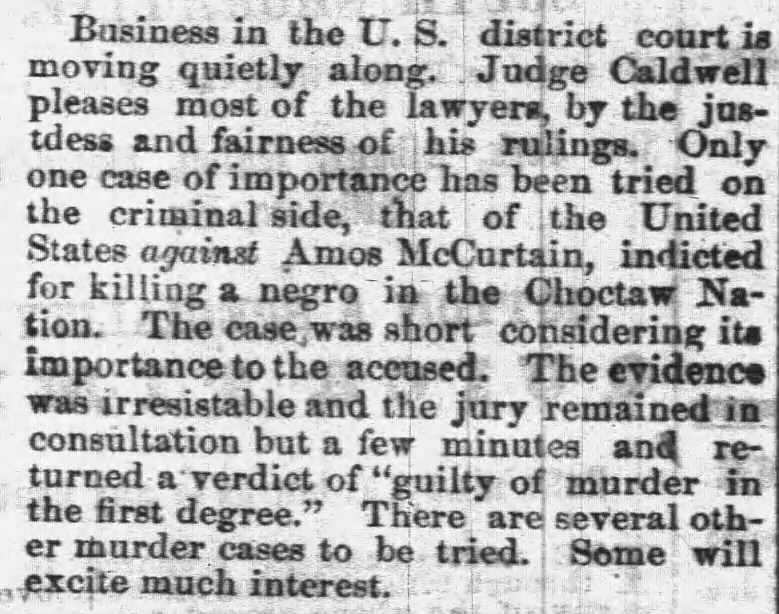
Amos McCurtain

Amos McCurtain was a member of the Choctaw Nation implicated in the murder of two Black men – James McClain and James Blakely – in that nation on September 7, 1869. After encountering the two men as they were traveling, McCurtain decided to kill them and steal their possessions.

After their bodies were found, investigators tracked down McCurtain. McCurtain’s traveling partner, William Fry, who had refused to participate in the scheme, provided evidence against McCurtain.

Daily Arkansas Gazette, November 28, 1869

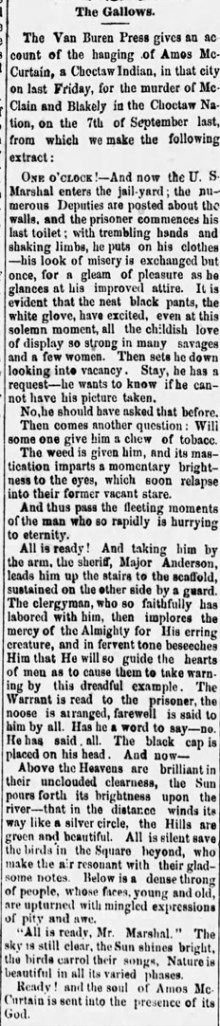
McCurtain was tried in U.S. District Court for the District of Arkansas and convicted of first-degree murder in November 1869. Sentenced to death in May 1870, he was hanged in Van Buren, Arkansas, on June 24, 1870.

Fayetteville Weekly Democrat, July 2, 1870

Willis Beard

Twenty years after Congress created the Court of the United States for the District of Arkansas and invested in with authority over the Indian Territory but before that court was divided into Eastern and Western Districts and Isaac Parker took his seat as the presiding judge over more death sentences and hangings than any federal judge in history, Willis Beard was the first man to be executed under federal authority in Arkansas.

Beard had killed John Kelley in the Cherokee Nation. He was convicted in the U.S. Court for the District of Arkansas and sentenced to death.

Willis Beard was hanged on May 29, 1857.

Arkansas Intelligencer, June 5, 1857