Juan Raul Garza

In the 1980s and 1990s, Juan Garza ran two businesses; a successful construction company in Brownsville, Texas, and a marijuana smuggling operation that operated between Mexico and Texas, Louisiana, and Michigan.

Suspecting that some of his employees in the smuggling business were cooperating with police, Garza ordered the murders of Gilberto Matos in April 1990 and Erasmo De Le Fuente in September 1990. He also shot and killed Thomas Rumbo in January 1991. Garza was also suspected in four murders in Mexico.

After U.S. Customs officers raided his Brownsville home on February 6, 1992, Garza fled to Mexico. He was arrested there on November 6, 1992. Extradited to the United States, he was indicted on January 3, 1992, on multiple charges under the Continuing Criminal Enterprise provisions of the federal Anti-Drug Abuse Act of 1988. Also known as the “Drug Kingpin Act,” this drug war-era legislation provided the death penalty for killings that occur as part of a drug enterprise.

U.S Attorney General William Barr, who as the Trump Administration’s Attorney General facilitated and oversaw all thirteen of the federal executions that occurred in the last months of his term, approved the capital charges against Garza.

Garza’s trial began on July 7, 1993. He was convicted on July 29 and sentenced to death on August 10.

After multiple unsuccessful appeals, an effort by the Inter-American Commission on Human Rights (IACHR) to reverse Garza’s sentence, and clemency petitions to President Clinton and President Bush, Juan Raul Garza was executed at the federal prison in Terre Haute, Indiana, on June 19, 2001.

Garza was the first person and, along with Cory Johnson, one of only two people, executed under the “Drug Kingpin” statute.

Wesley Ira Purkey

In another case originating in Kansas City, Wesley Purkey kidnapped, raped, and killed 16-year old Jennifer Long in 1998. A troubled East High School sophomore, Long skipped school on January 22, 1998.

Later that day, she got into Purkey’s truck, apparently voluntarily. Beyond that, the precise circumstances of her death are lost.

Her disappearance was initially attributed to family issues before being reclassified as suspicious.

Purkey was arrested months later for the murder of 80-year old Mary Ruth Bales in Kansas. In custody, on December 15, 1998, he confessed to killing Long, whose body he said he dismembered and burned; her remains were never recovered. Before committing the killing, Purkey stated that he crossed from Missouri to Kansas, triggering federal jurisdiction.

Purkey, who had a long criminal record and a history of drug problems, was charged with Long’s murder in October 2001. He was convicted and sentenced to death in 2003.

Efforts to prevent Purkey’s execution centered on evidence that he suffered from Alzheimer’s disease, schizophrenia, and brain damage. A federal district judge issued a stay of the basis of that evidence. That stay was upheld by a federal appellate court. However, the Supreme Court vacated that stay by a 5-4 vote and the Trump Administration, of course, refused to intervene.

Wesley Ira Purkey was executed by lethal injection at the Federal Correctional Complex in Terre Haute, Indiana, on July 16, 2020. He was 68-years old and had been on death row for almost two decades.

Louis Jones Jr.

Louis Jones Jr., a 44-year old Black retired U.S. Army veteran, kidnapped, raped, and murdered Tracie Joy McBride, a 19-year old white U.S. Air Force private on February 18, 1995.

McBride, who was stationed at Goodfellow Air Base in San Angelo, Texas, was kidnapped from the base laundry, driven to Jones’ home, raped, and driven to a remote area in Coke County where she was beaten to death.

Jones, a decorated 22-year Army veteran, was arrested on March 1, 1995, on charges related to the beating of his ex-wife. Under questioning by Air Force investigators, Jones confessed to killing McBride.

Because the abduction occurred on a military base, Jones was tried in federal court in Lubbock, Texas, in October 1995. Considerable physical evidence and his own confession implicated Jones. In his defense, he emphasized childhood trauma related to physical and sexual abuse as well as combat-related trauma. He was convicted on October 23 and sentenced to death.

On appeal, his defense continued to emphasize the trauma Jones had experienced, including nerve gas exposure and Gulf War Syndrome.

In 1999, the U.S. Supreme Court rejected Jones’ appeal. In 2003, President George W. Bush rejected his clemency petition and the Supreme Court rejected his final appeal.

Louis Jones Jr. was executed at the federal prison in Terre Haute, Indiana, on March 18, 2003.

John Pointer

There is no doubt that John Pointer was present when a man named Blue was killed in the Choctaw Nation on September 10, 1872. The extent of his involvement in that death is less clear.

According to Pointer, an 18-year old Seminole, the fatal incident began when his companion, Sam McGee, declared his intention to kill Blue, a white drover who was passing by. Pointer says he opposed that plan and fled the scene.

Pointer was arrested; he claims that McGee used his connections to protect himself and implicate Pointer.

Pointer was convicted of murder and sentenced to death. Along with two other men, both of whom were Choctaw, he was hanged on April 3, 1874.

New York Times, April 13, 1874

Sinker Wilson

Sinker Wilson, a Cherokee man, was convicted and sentenced to death for killing Datus Cowan, a white boy, in 1867. His execution was scheduled for February 7, 1868.

While awaiting execution, he escaped from the Van Buren County jail. Wilson lived free for the next nine years, until being arrested in April 1876 for his involvement in new crimes.

Taken to Fort Smith for trial before Judge Parker, Wilson denied being the person sentenced to death a decade earlier. The jury found otherwise and Wilson was found guilty on June 2, 1876, and sentenced to death on June 21.

Sinker Wilson was hanged on September 8, 1876.

Silas Hampton

Abner N. Lloyd was part of a crew working to build a new railroad in Tishomingo County, Indian Territory. As he slept rested on the night of December 9, 1886, Silas Hampton robbed and murdered him.

Hampton left the scene to return a horse he borrowed and to go to town to buy some goods. In the course of those interactions, he left behind enough clues to become a suspect once Lloyd’s body was discovered.

Hampton also told some of his friends what he had done.

Hampton was arrested on December 11. He was tried before Judge Parker and convicted on July 9, 1887. He was hanged on October 7, 1887.

Daniel Evans

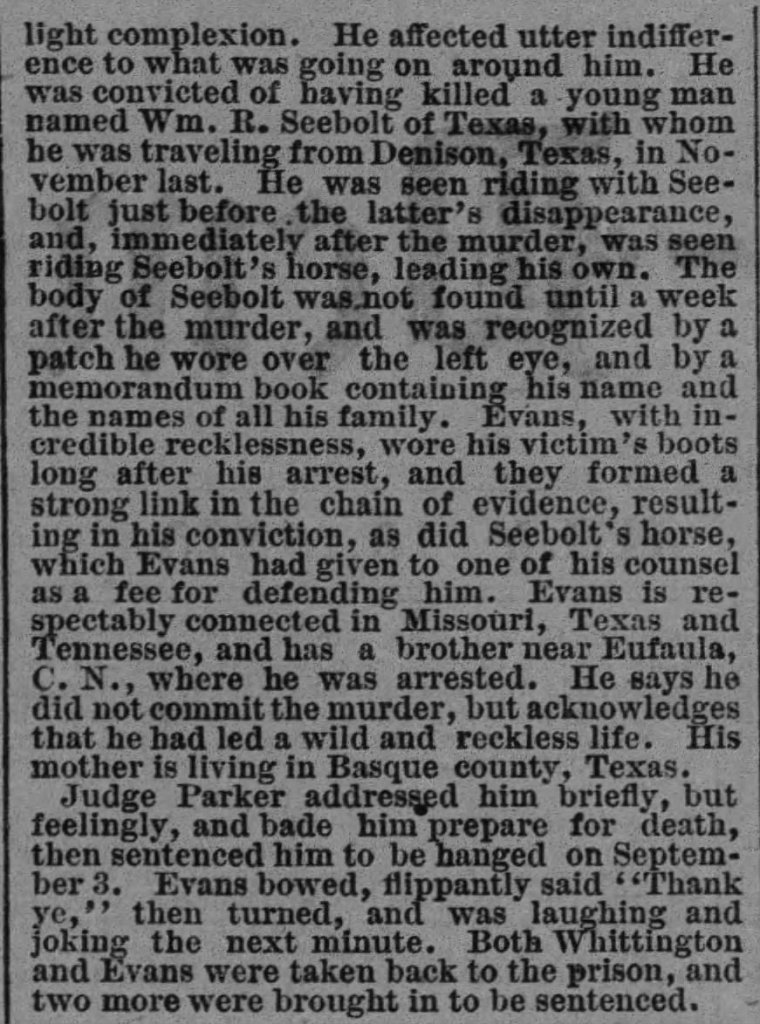
William R. Seabolt and Daniel Evans were riding together from Dennison, Texas into the Choctaw Nation. Near Eufaula, in the Choctaw Nation, Evans killed Seabolt.

Suspicion was aroused when Evans was seen riding Seabolt’s horse. A week later, Seabolt’s body was found.

St. Louis Globe-Democrat, July 15, 1875

Evans was tried and convicted before Judge Parker on June 16, 1875. Sentenced to death, he was executed on September 3, 1875. Five other unrelated men were hanged the same day.

Samuel Fooy

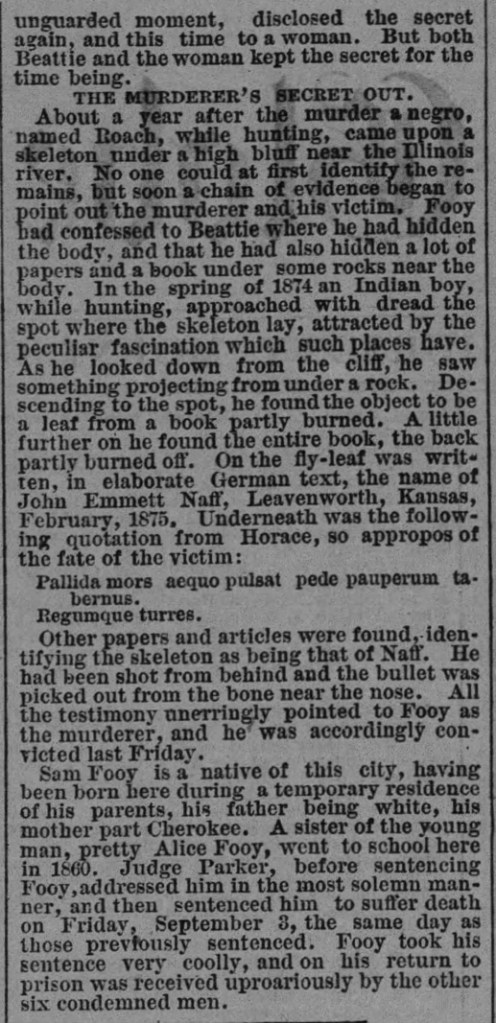
John Emmett Naff was a teacher near Tahlequah, in Indian Territory. With his pay in his pocket, Naff was last seen traveling by foot with Samuel Fooy on July 17, 1875.

A few weeks later, Fooy confided in family that he had killed Naff. He then told a woman he was involved with. Neither admission had any immediate consequences.

About a year later, Naff’s remains were found near the Illinois River. With an investigation now under way, Fooy was identified as having killed Naff.

He was convicted and sentenced to death by Judge Parker on June 28, 1875. With five other unrelated killers, Samuel Fooy was hanged on September 3, 1875.

Smoker Mankiller

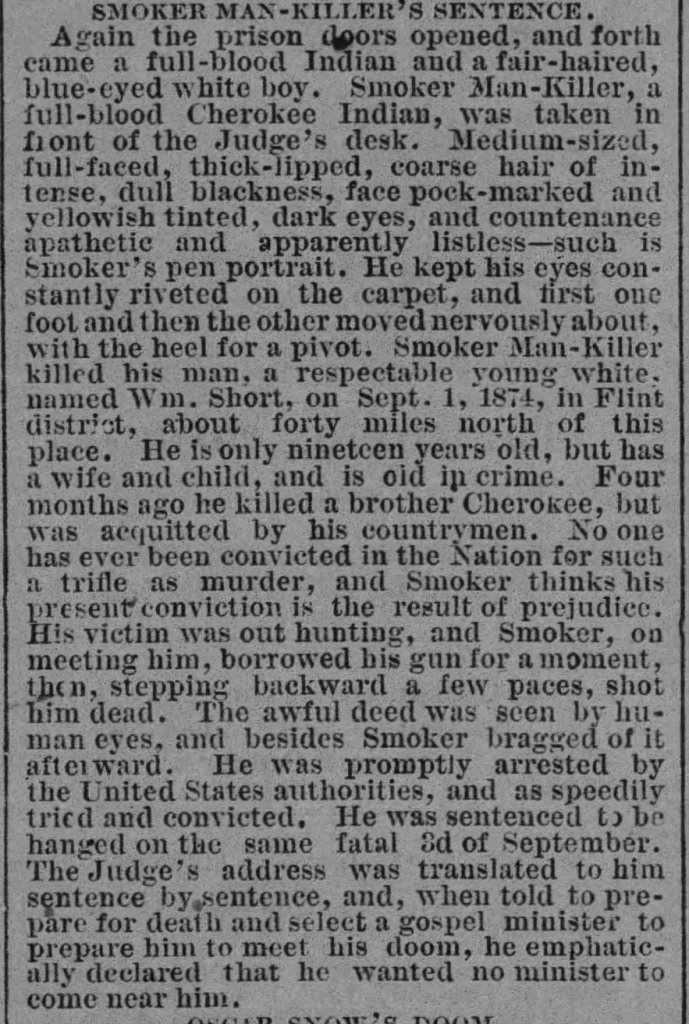
William Short was hunting near Smoker Mankiller’s home in Indian Territory when Mankiller shot him on September 1, 1874. Short survived the shooting, only to be tracked down and stabbed to death by Mankiller.

St. Louis Globe-Democrat, July 15, 1875

Mankiller was arrested by U.S. Marshals. At trial before Judge Parker, he was convicted and sentenced to death on June 26, 1875.

Smoker Mankiller was hanged on September 3, 1875, along with five other men convicted of separate murders.