Documenting and Analyzing the History of Federal Executions
Author: Bill Lofquist
I am a sociologist and death penalty scholar at the State University of New York at Geneseo. I am also a Pittsburgh native. My present research focuses on the history of the death penalty in Allegheny County (Pittsburgh), Pa.
When Cyrus Brown became ill in late 1896, Daniel Cuthbert cared for him on his houseboat on the Arkansas River near Webbers Falls, in the Creek Nation south of Muskogee. When Brown was feeling better, he killed Cuthbert and stole his boat.
When Cuthbert’s body was found, attention focused on Brown. He was arrested in Fort Smith and returned to Muskogee for trial in federal court. The jurisdiction of the federal court for the Western District of Arkansas ended in 1896.
Cyrus Brown was found guilty of first-degree murder on July 23, 1897, and sentenced to hang on December 18. He was hanged in Muskogee on August 25, 1899.
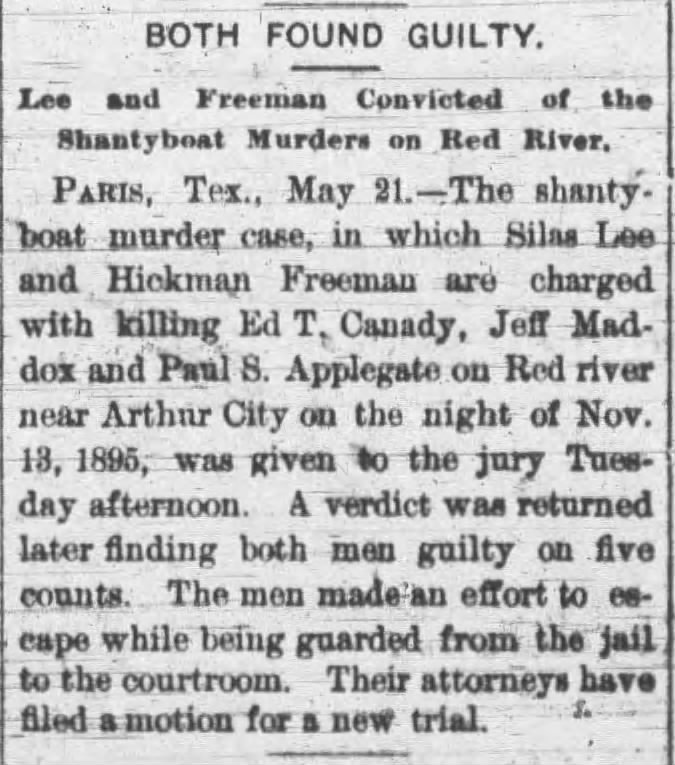
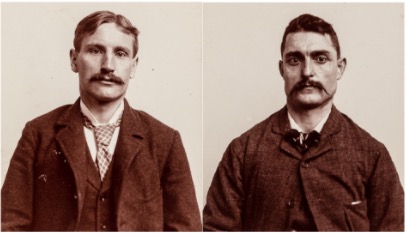
Silas Lee and Hickman Freeman, Black men who lived in the Indian Territory near Goodland, killed Ed Canady, Paul Applegate, Jeff Maddox, and an unidentified man on November 14, 1895. The four men were on a boat in the Red River near Arthur City. The motive was robbery.
Lee and Freeman were arrested two weeks later. Property belonging to the dead men was found in their possession.
Transported to Paris, Texas, the men were tried in the newly established federal court for the Eastern District of Texas. Only a modest defense was offered. After being convicted on May 19, 1896, the two men were sentenced to death on June 27, 1896.
Evening Messenger (Marshall, Texas), May 21, 1896
Silas Lee and Hickman Freeman were hanged at Paris, Texas, on September 4, 1896.
On April 12, 1888, Thomas Willis hosted several other men for an evening of whiskey drinking at his home near Albion, Indian Territory.
The next day, the still drunk men – Willis, John Billy, Madison James, Stephen Graham, and W.P. Williams – got into a fight. Willis shot and killed Williams, who was white, robbed him of money and whiskey, and buried him.
Williams’ body, which had not been buried very deep, was found a few weeks later. Willis, Graham, James, and Billy were arrested.
Taken to Fort Smith to stand trial, Billy, Willis, and James, all of whom were Choctaws, were convicted of murder on October 4, 1889, and sentenced to death on November 1. Graham had not been indicted due to evidence that he had not participated in the crimes.
Madison James’ death sentence was commuted to fifteen years in prison on January 14, 1890.
John Billy and Thomas Willis were hanged in Fort Smith on January 16, 1890.
Houston Joyce was traveling through Indian Territory after leaving his home in Franklin, Texas. When he stopped to eat at the Choctaw Nation home of Jim Goin, his hosts became aware that he was traveling with money. After giving him directions, Jimmon Burris and Sam Goin followed Joyce, robbed him, and killed him.
After Sam Goin told an associate of his crime, that man told authorities. Once Joyce’s body was found, Burris and Goin were arrested.
Taken to Fort Smith to stand trial in October 1889, Burris and Goin were convicted of murder. They were sentenced to death on November 1.
Prior to their executions, Burris and Goin confessed to two other murders.
Jimmon Burris and Sam Goin, both Choctaws, were hanged at Fort Smith on January 16, 1890.
The five men known collectively as the Rufus Buck Gang were notorious around Okmulgee, Creek Nation, in the summer of 1895. All except for Lucky Davis were Creek; Lucky Davis was white.
Their first recorded crime is a store robbery that led to the murder of Deputy Marshal John Garrett on July 30. Following in short order were a series of rapes, robberies, and assaults, as well as the murder of Sam Huston on August 4.
Following a gunfight with marshals, four of the five men were apprehended on August 8. Lucky Davis escaped, only to be apprehended the next day.
In a fast-moving series of events, the five men were taken to Fort Smith to stand trial. Tried first for the rape of Rosetta Hasson, they were found guilty on September 23. A separate trial for the murder of John Garrett led to guilty verdicts against Buck, Lewis Davis, and Lucky Davis on September 24.
After unsuccessful appellate and clemency efforts, Rufus Buck, Maoma July, Sam Sampson, Lucky Davis, and Lewis Davis were hanged at Fort Smith on July 1, 1896. They were the only men hanged at Fort Smith for rape.
On January 14, 1895, brothers George and John Pierce and William Vandevere were seen together on horseback near Tahlequah, Indian Territory. The following day, a gunshot was heard from the direction in which they had traveled and the Pierce brothers were soon after seen returning from that direction.
Investigation led to Vandevere’s body. A posse was formed and the Pierces were arrested in Tahlequah.
Taken to Fort Smith to stand trial, the Pierce brothers were convicted of murder on March 1, 1895.
After delays for the consideration of appeals, George and John Pierce were hanged in Fort Smith on April 30, 1896.
On January 13, 1893, Hans Hansen, Thomas St. Clair, and Herman Sparf, while serving aboard the American vessel, Hesper, killed Maurice Fitzgerald and threw him overboard.
Alerted to the events on deck and the absence of Fitzgerald, Captain Franz Sodergren was immediately suspicious of what had happened and placed Hansen, St. Clair, and Sparf in custody. When blood, flesh, and a hatchet were found on the deck the next morning, the events of the previous night became clearer.
The Hesper was sailing from Australia to Hawaii with a crew of fourteen. The three men remained in custody until reaching port in Tahiti.
It subsequently emerged that the killers had planned to kill the captain and take control of the vessel.
Transported to San Francisco to stand trial in the Circuit Court of the United States for the Northern District of California, Thomas St. Clair was tried first. He was convicted on June 20, 1893, and sentenced to death on July 5. Hansen and Sparf were tried together in August, convicted on August 25, and sentenced to death on September 18.
In a long series of appeals and controversial opinions reaching all the way to the United States Supreme Court, the convictions and death sentences of Hansen and St. Clair were upheld and Sparf’s conviction was reversed.
Hans Hansen and Thomas St. Clair were hanged at San Quentin on October 18, 1895.
John McGuire was an old man living alone in a small house in Antlers, Indian Territory, just north of the Texas border. In January 1894, Eugene Fulke moved in with him. Soon after, McGuire disappeared.
When asked about McGuire’s whereabouts, Fulke gave conflicting reports. He also claimed that he was McGuire’s nephew and heir. With local residents suspicious of Fulke and convinced McGuire had been killed, Fulke was arrested soon after McGuire’s body was found.
Taken to Paris, Texas, to stand trial in federal court, Fulke was tried in June 1894 and quickly convicted and sentenced to death.
Eugene Fulke was hanged in Paris, Texas, on September 28, 1894.
William Walker killed his neighbor, Calvin Church near Durant, Choctaw Nation, in December 1887. The killing followed a dispute over an axe that escalated into a verbal confrontation and then murder. Both men were Black.
Arrested soon after the killing, Walker was taken to Fort Smith for trial. He was convicted of murder in February 1889 and sentenced to death on April 29.
Jack Spaniard, a Cherokee man raised in Cherokee Nation with a criminal record for violence, killed Deputy Marshal William Erwin at Webbers Falls, Indian Territory on April 12, 1886. Spaniard was trying to free Felix Griffin, an associate who Erwin had arrested and was transporting to Fort Smith.
Erwin’s body was found the next day. Despite a $500 reward, Spaniard was not arrested until March 17, 1888. Tried soon after, Spaniard was convicted of murder. He was sentenced to death on April 29, 1889.
Jack Spaniard was hanged at Fort Smith on August 30, 1889.
 The Federal Death Penalty Project