Kitt Ross

Though Kitt Ross and Jonathan Davis appeared to be on good terms, there had been altercations between them over the years. So, it was not a complete surprise when an ordinary encounter between the two men at a store in Choteau, Cherokee Nation, on December 20, 1885, Ross killed Davis. There were multiple witnesses.

When captured six weeks later, Ross confessed. His only defense was drunkenness.

At trial, Kitt Ross was convicted of murder and was sentenced to death on July 23, 1886. He was hanged at Fort Smith on August 6, 1886.
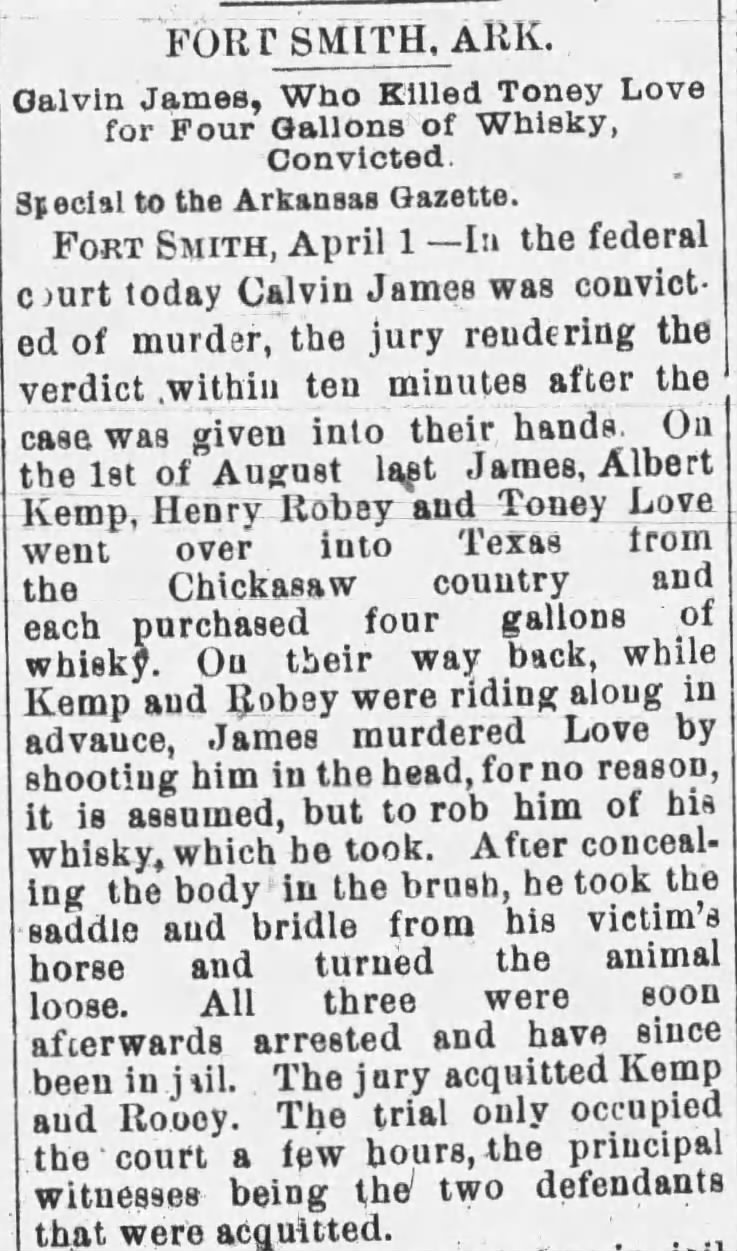
Calvin James

Henry Reuben, Albert Kemp, Tony Love, and Calvin James, who lived near Tishomingo, traveled together to Texas in July 1885 to buy whiskey, which was illegal in the Indian Territory.

As they returned, James killed Love, who was holding the whiskey. Both men were Black.

When Love did not return home, his family began a search. The men were captured and taken to Fort Smith.

Daily Arkansas Gazette, April 2, 1886

At trial, Kemp and Reuben testified against James, avoiding prosecution as a result. James was convicted of murder and sentenced to death in early May 1886. With two other men, he was hanged on July 23, 1886.

Lincoln Sprole

Father and son Benjamin and Alexander Clark farmed near Pauls Valley, Chickasaw Nation. Lincoln Sprole, known as peaceful and not particularly bright, farmed neighboring land with a man named Perry.

In May 1885, Sprole and Perry got into an argument with Alexander Clark, whose reputation suggested trouble. Neighbors who intervened to calm tensions found Sprole and Perry armed and waiting for Clark. When Clark arrived, trouble seemed imminent until Ben Clark came and took Alex home.

The next day, Benjamin and Alexander Clark were found shot in their wagon. Before dying, both identified Sprole as the shooter.

After fleeing into Kansas, Sprole was arrested and returned to Fort Smith to await trial. He was convicted of murder and sentenced to death in May 1886. Lincoln Sprole was hanged on July 23, 1886.

James Wasson

James Wasson and Johnny McLaughlin killed Henry Martin near Harney, Chickasaw Nation, in November 1881. Apparently out of fear of the dangerous reputations of the two men, they were allowed to leave the area despite witnesses to the killing.

Even when he returned to the area years later, Wasson remained unmolested by the police. Following some drinking on July 28, 1884, Wasson shot and killed another man, Almerine Watkins. When Watkins’ widow posted a generous bounty, Wasson was finally apprehended on September 28, 1884.

Taken to Fort Smith, Wasson was convicted of killing Martin and sentenced to death. His claim of self-defense did not persuade the jury.

Finally arrested, McLaughlin was tried three times for killing Martin. After two hung juries, he was acquitted. A conviction was expected; his wealthy and influential family may have affected the outcome.

James Wasson was hanged on April 23, 1886.

William Phillips

Willam Hill and William Phillips were neighbors in Franklin County, Arkansas, when Phillips persuaded Hill’s fourteen-year old daughter to marry him. The couple married in Fort Smith.

Though Hill did not like Phillips and was opposed to the marriage, he decided to stay near them when they moved into the Cherokee Nation, just outside Fort Smith. Tension between the men escalated until Phillips shot Hill. Hill survived and filed charges.

On September 8, 1884, tensions erupted again. That night, Phillips killed Hill while he slept. Phillips was quickly arrested.

With eyewitnesses and other testimony, the case against Phillips was strong. In his defense, Phillips argued that Hill’s, Robert, who had also argued with his father, was the killer.

William Phillips was convicted of murder on January 20, 1885, and sentenced to death on January 31. He was hanged at Fort Smith on April 17, 1885.

Thomas Lee Thompson

Though they had known one another only for a short time, James O’Holerand and Thomas Lee Thompson lived together in a remote area near Stonewall, Chickasaw Nation. Sometime in September 1883, O’Holerand went missing. In such a remote area, the disappearance of an outsider could have been concealed.

However, Thompson’s frequent expressions of concern about him and the inconsistent stories of his absence drew attention. Subsequent investigation and questioning led to further evidence and, ultimately, a confession of sorts. O’Holerand, Thompson claimed, attacked him and was killed in self-defense.

Thompson was convicted of murder on February 22, 1884, and sentenced to death on April 28. He was hanged at Fort Smith on July 11, 1884.

John Davis

William Bullock, who was white, was driving cattle from Arkansas across the Indian Territory in spring 1883. On his return on June 27, 1883, he encountered a Choctaw named John Davis. Through conversation, Davis determined that Bullock was carrying a good sum of money. As Bullock continued, Davis carried out his plan to rob and kill him.

Bullock’s body was found three days later. No one could identify him. However, a drunken Davis soon boasted of his crime and was promptly arrested.

John Davis was convicted on February 27, 1884, and sentenced to death on April 28. He was hanged at Fort Smith on July 11, 1884.

Jack Womankiller

On May 7, 1883, Nathaniel Hyatt and Jack Womankiller were seen traveling together near the border of Arkansas and the Cherokee Nation. Three days later, Hyatt’s body was discovered. The money he was known to be carrying was missing.

Womankiller, who had previously boasted of his plans to kill him, was promptly arrested. He confessed. The case against Womankiller was incontrovertible.

At trial in Fort Smith, Womankiller was convicted of murder and sentenced to death. He was hanged on July 11, 1884.

Martin Joseph

Martin Joseph, Henry Loftis, and Bud Stephens ran a horse stealing ring in the Chickasaw Nation. In April 1882, the former two men, who were Black, developed and carried out a plan to kill Stephens, who was was white. They then took Stephens’ wife to a remote area and raped and killed her.

Joseph later confided in Loftis’s brother, William, what they had done. When William told others, Joseph killed him. When Henry Loftis confronted Joseph, he was also killed.

With witnesses to Henry’s murder and stories circulating, the search for Joseph commenced. He was arrested and taken to Fort Smith.

With considerable physical evidence and witnesses against him, Joseph was convicted in April 1883 and sentenced to death on May 5. Martin Joseph was hanged on June 29, 1883.

Te-O-Lit-Se

Emanuel C. Cochrane was traveling through the Indian Territory on his way home to Texas from Eureka Springs, Arkansas. Te-O-Lit-Se was seen following him on July 6, 1881, and is alleged to have robbed and killed him near Okmulgee, Chickasaw Nation.

Investigation led to Te-O-Lit-Se, who was arrested and taken to Fort Smith in August 1882. On trial there in March 1883, he was convicted of murder and sentenced to death.

Te-O-Lit-Se was hanged at Fort Smith on June 29, 1883.